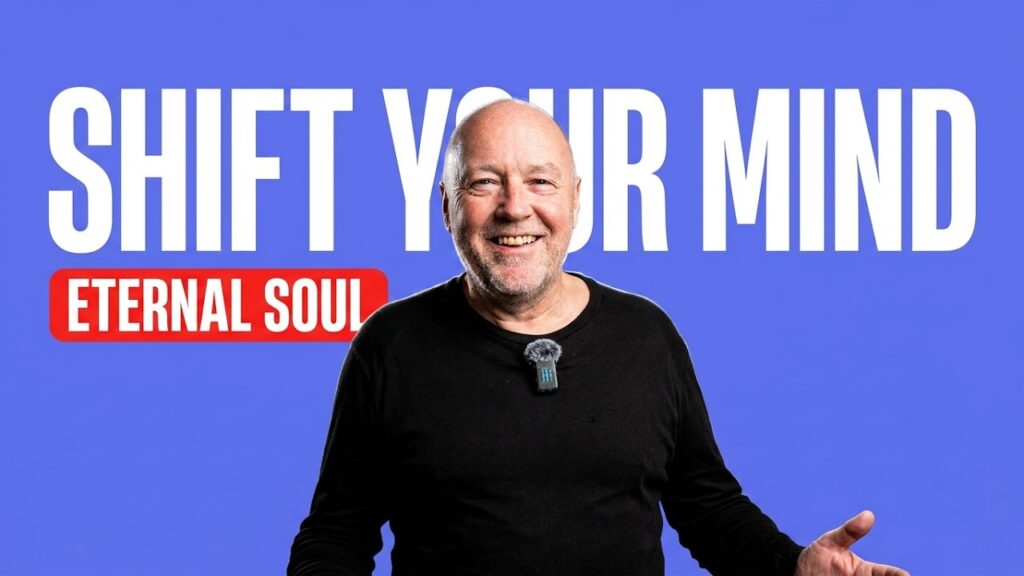
When you are stuck in a ditch and cannot see a way out, what is the first thing you can do?
In this twelve-minute talk Hans answers while walking through a busy neighbourhood in the Philippines, greeting people and stopping for a few words along the way. The advice is practical and gentle: wake up to the fact that you are putting yourself down, remember that it is your choice, and change your point of view. The talk then widens into a spiritual reminder that every ending is also a beginning.
This is a personal reflection offered as one voice among many. It is not medical, psychological or professional advice. If your situation feels unbearable, please reach out to a trusted person or a local support service.
Wake up and see what you are doing
Hans begins with awareness. When you are in a hard situation and can’t see what to do, “the first thing that is important for you is to be aware of it. Just wake up.” He then says something that may be uncomfortable: you are making yourself feel down, and “it’s your choice. You do not have to be that way. You could lift yourself up.” That is not a claim that hardship isn’t real, and he does not say circumstances are easy. His point is that the reaction is the part you can work with.
Change your point of view, literally
The first exercise is almost physical. Instead of looking this way, look that way, and notice that things look different. Hans admits this isn’t always easy, because we are used to seeing everything in black and white, but “that’s not your only choice. When you are ready, you can see things in colour.”
He then moves to the mind. “Mainly it’s not so much about the things that happen in life. It’s more what point of view, what is your reaction to them.” A good question to put to yourself is: is it really so? We often explain our problem to others in great detail, collecting arguments for why our point of view is right.
Imagine the opposite
As an exercise, Hans suggests imagining the opposite, or imagining someone who looks at the same problem and sees something positive in it, something there to teach you. Take the terrible problem apart, scratch the surface and ask whether there is anything good in it. “Just pretend. Have a little look.” He offers this as a tool for changing your mindset, not as a command to feel grateful.
Are you addicted to your problems?
The most pointed passage is about identity. We sometimes get “a little bit addicted to our little problems”, Hans says, because they define us: “I’m the guy who was mistreated by that other person. I’m the victim here.” His suggestion is playful. If you are the victim, try pretending to be the villain, the hero, or whatever the opposite of the victim is for you. “You define it for yourself.” It is an experiment in loosening a story, and he encourages listeners to try it out.
Patience, a roller coaster and a spilled ice cream
Midway, Hans chats with a couple of delivery riders and reflects on what he sees around him. They have a harder time because of the war that is pushing up fuel prices, he explains, while customers are used to prices from four weeks earlier. That fits the wider picture in the Philippines in 2026, where oil price shocks linked to the conflict in the Middle East drove up inflation; see this report on March inflation. Yet the riders keep going. Filipinos are “very, very patient”, Hans says, and patience means waiting for good things to happen, because “things happen by themselves”.
Looking back, life has always been a roller coaster, with things going up and down. Freaking out when things go down is like a child whose ice cream falls on the floor before the dog eats it: “Oh my god, this is the end of the world.” Later the child finds out it isn’t. Be like that child, Hans says: cry a little, then remember it’s not that much of a problem. “It’s more how you deal with it and how much you think that it is important and real and essential for your life.” Maybe, he adds, have a little dance.
There is no end
The closing turns to the non-dual view. “The end is near. The end is continuous. Every moment is ending, and every moment is a new beginning. It’s the same.” What you are, he says, is a living being, a soul, spirit, and that is eternal: “There is no death and there is no end.” So when something terrible happens, it doesn’t mean it is the end. “Sooner or later, you find out it was not the end.”
Questions to take with you
Which story about yourself are you defending right now, and what would it look like from the opposite side? Hans explores neighbouring ideas in Pleasure and Pain: The Friction Behind Suffering and Fear of Death: Who Are You Beyond It?. Watch the video above and share your own change of view in the comments.
Key themes
- 1:00 — When you are in a ditch: the power of awareness
- 1:06 — The first step: changing your point of view
- 1:52 — Seeing life in colour instead of black and white
- 2:12 — Why your reaction matters more than the problem
- 3:02 — Are you addicted to your problems?
- 3:41 — Beyond the victim: choosing a new identity
- 4:30 — Lessons in patience from the Philippines
- 5:15 — Navigating the roller coaster of life
- 5:46 — The ice cream lesson: why life always goes on
- 6:40 — Every moment is a new beginning
- 7:00 — The eternal truth: you are a living soul
- 7:23 — Why there is no such thing as “the end”