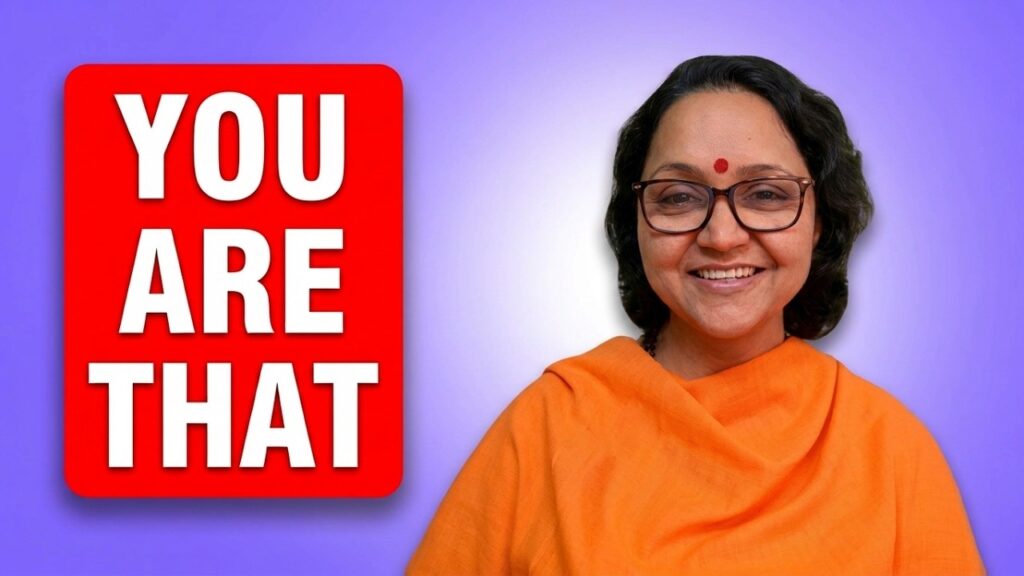
What if waking up is only half of the journey?
That is the question at the heart of this conversation between Hans and Swamini Brahmaprajnananda, a Hindu monk (sannyasini) from Mumbai, former clinical psychologist and teacher of Advaita Vedanta in the Arsha Vidya tradition. After several interviews with Western teachers who describe themselves as radical or direct-path non-duality voices, Hans asks her what a traditional lineage offers that a sudden recognition does not.
What follows is Swamini’s personal perspective and the teaching tradition she represents, as shared in the conversation. Other guests on this channel hold different views, and we share this as one voice among many. Nothing here is medical or psychological advice.
A prayer before beginning
The interview opens in the traditional way, with a prayer. Swamini explains that it was an auspicious day, the day on which Lord Krishna’s birth is celebrated, and she chanted two prayers: one of salutation to the whole lineage of teachers, “all the way to Lord Shiva” and especially Adi Shankaracharya, who re-established Advaita Vedanta, and one to Krishna as the teacher of the world, through whom the Bhagavad Gita was revealed.
She notes that the Gita’s dialogue takes place on a battlefield, “a most unusual place for any kind of teaching”, which she compares to our own lives. And she describes the tradition’s attitude to knowledge: nothing is really created, things are only discovered, and whatever she knows was shared by her own teachers. Asked who she is, her one-line answer is, “I am full.” She admits that does not explain much, so she tells the story.
From convent school to a Vedanta class
Swamini grew up in Mumbai, studied in a convent school, and as a rebellious teenager told her grandfather she wanted to convert to Christianity because Hinduism “did not make sense”. His reply was sharp and kind: she had no reason to criticise what she did not know. He gave her books by Swami Vivekananda, Osho and J. Krishnamurti, and at eleven or twelve she began to read. She decided to put the question of God aside for a while, and turned instead to human beings, training as a clinical psychologist and then moving into social work.
She found modern psychology limiting, in that “there’s always something to be done” and everyone is “a work in progress”. Even though she was doing very well professionally in her early twenties, her life felt empty. Then she walked into a Vedanta class. “I knew this was home.” The teacher answered her questions with logic and scripture, and she committed her life to it. Alongside her studies she spent about fifteen years working for street children, heading the India programme of an international organisation, and she says that work helped almost 120,000 children. Before taking monastic vows she spent three and a half years in a traditional residential school (gurukulam) in southern India, and she has now taught Advaita Vedanta for thirteen years.
“I am not enough” is a spiritual problem
Hans asks what resonated when she first heard Vedanta. Her answer is that it named the human problem. Topical problems come and go (a fight with a boyfriend, poor health, a layoff), but underneath is a strong belief: “As I am, I am not enough.” She stresses that this is not a self-esteem issue, because worth based on a body and mind that are constantly changing has nothing stable to stand on. What Vedanta says instead is that you are not only enough, you are the limitless fullness you have been seeking.
She points to an everyday clue. When someone says you have really changed, you tend to answer, “No, not really.” That is the sense of an unchanging “I” that most of us never examine. The diagnosis, she says, has to be correct. If the problem is ignorance of oneself, the solution is knowledge. And everyone wants to be happy, because happiness is a return to our true nature. “All my seeking was because I wanted to be free from seeking.”
What non-duality means: one water, many waves
Asked to describe non-duality briefly, she explains that advaita literally means “not two”, a slightly odd definition, but it points to one without a second. With duality comes a sense of separation, and the loneliness and disconnection that go with it. Her image is water and waves. There is only one water, appearing as many waves. A wave does not exist apart from the water, and a wave that travels from the Atlantic to the Indian Ocean remains water throughout. The forms are appearances (mithya) and the one reality is satyam. A framework of dharma, universal ethics, governs how the waves relate to each other.
Can anyone just wake up?
This is the central challenge Hans puts to her. Many of his guests have no lineage and simply say they woke up. Is a guru necessary? Swamini begins with good news: anyone can wake up, because everyone is already free. Awakening is like clouds dispersing so the sun can be seen, and she calls it “a big blessing”.
Her concern is what comes next: “Then starts living in the real world.” Many people, she says, cannot live that insight. It is like having a superpower the body is not able to absorb. Without the support of a lineage, she has seen some become outcasts or upset their personal lives, because the tradition has a systematic way of preparing the student. She says she has counselled many people who had such an insight and needed traditional Vedanta to assimilate it.
Two themes: self-discovery and self-mastery
Swamini credits the direct path for what it does well. Because it starts from present experience (what is aware right now? what changes and what doesn’t?), it leads people quickly to recognise the “you” of the great sentence Tat Tvam Asi, “you are that”. It asks for no belief, no God and no cultural conversion, which is attractive to secular listeners with good reasons to distrust authority figures.
But she says this is only half of the sentence. Tvam is “you”, the witness, unchanging consciousness. Tat is “that”, pointing to the source of the whole creation, which the tradition calls Ishvara, a word that is not gendered and could as well be a goddess. The inquiry must include both, because the sentence says they are one. She adds that Ramana Maharshi, whom many direct-path teachers honour, also wrote about God, karma yoga, dharma, meditation and mantra repetition, so “anyone who’s committed to truth cannot have biases or filters”.
Two themes run in parallel in the tradition, she says: self-discovery, who I am, and self-mastery, how I live in the world. The direct path works with the first, partially, and then says to keep going. Self-mastery is the part her tradition adds.
The test: how do you get on with your family?
Her “million dollar question” for anyone on the direct path is simple: how do you get on with your family? The answer, she suggests, reveals whether you are in harmony with the world, which the tradition sees as a manifestation of God.
Hans offers the objection of someone who says they have left their family behind, free of attachment. Swamini replies that the Sanskrit word vairagya, which she translates as objectivity, is a qualification in Vedanta, but it is not hatred, aversion or indifference. If you walk away from your family and say you have vairagya, you may simply have aversion.
She introduces dharma, with no exact English equivalent: a universal framework of values, the nature of a thing (the dharma of water is to flow), and also life in the hereafter. Even a child knows he doesn’t want to be hurt. Dharma rests on mutual reciprocity. We are born into relationships with duties attached, and “in the name of spirituality, if I say I am free, I want to walk away from them, is highly irresponsible”. She is careful about abuse: if parents were abusive, you may not need to engage actively, but the principle of care can still be upheld, for instance by paying someone to look after them, or by working toward at least a cordial relationship.
She also notes that many people leave family for community and are then disillusioned by the community, because they have not learned to work with disillusionment at home. Relationships, she says, are deeply spiritual, as they are where we mature.
“I am not the doer”: instrument, not nothing
Hans repeats what he hears from his radical non-duality guests: I do not exist, there is nothing to do, everything is done through us. Swamini’s reply is a precise one. If someone says “I don’t exist”, who is saying it? It is like saying “I don’t have a tongue” while speaking. In Sanskrit, “I am not the body” means not that the body doesn’t exist but that “I am other than the body”. The body and mind are instruments, and the one who uses them is you.
So if radical non-duality teachers truly see themselves as instruments, she says, that is wonderful, and it is exactly what Krishna teaches in the Gita with the phrase nimitta-mātram, “merely an instrument”. Her image is the flute that has no preference for heavy metal or classical music, and lets whatever needs to be played come through it. “Being an instrument is very, very joyful.” Everyone also has unique talents and a contribution to make, and she argues we need innovators and service providers in every field.
Why a teacher, and why a living one?
On the “nothing to teach” position, she is direct: “Anyone who says I am not a guru, I cannot teach, and still teaches, is not taking accountability.” The tradition, she says, has no self-appointed teachers. Every teacher was a student, walked the path, and teaches only when their own teacher says they are ready. Her teacher, Swami Dayananda Saraswati, trained roughly 500 teachers, which she takes as a sign that the method works: “If a teacher is not able to create another teacher, that means that there is something lacking in that person’s methodology.”
She names the key elements. First, transmission by a living teacher, through questions and dialogue. Teachers who have died can inspire, but for current knowledge you need a living guru, and the teacher does not ask the student to believe anything, but to question until there is absolute clarity. Second, trust grows gradually, as it does when we trust a financial adviser, an Uber driver or a delivery service, and as the student sees more of the scripture’s vision. Third, readiness: the knowledge is sacred and also “secret”, she says, not because anyone is kept out but because it is sitting in your heart. It is you.
From stressed-out doer to instrument
The most detailed section of the interview describes a path she presents in stages. A stressed overachiever believes they call all the shots. Then life, through illness or the birth of a child with special needs, shows that there are many variables outside their control. They wake up to a cosmic order, what the tradition calls karma, and recognise that even the body is on loan. Doing shifts from consumption to contribution: asking what would serve everyone concerned. Doership loosens, and self-worth comes less from the CV and more from how one engages with the world with intelligence, compassion and devotion. At the end, “I am not the doer” rings true, because consciousness was never the doer.
The same path applies to being an experiencer. At first, a hurt person feels life has been unfair. Then they see that others also have their own backgrounds and karma, and they learn to receive what comes with grace.
The temple offering
Swamini’s illustration is a familiar Hindu practice. You bring a sweet or a chocolate to the temple, the priest touches it to the deity and returns it, and your vision of it changes. It was an ordinary object. Now it is sanctified, and you receive it with folded hands. In the same way, she says, we can learn to receive the events of life as coming from the order that God pervades. “My suffering is because I resist reality.” When resistance drops, we can graciously accept, change what can be changed, and eventually see that we are not even the experience: experiences come and go, while consciousness is present in all of them.
Why self-help is not the end
She is not dismissive of self-improvement, but she asks where it ends. Without the tradition, she says, the world of self-help is “a new age version of modern psychology” with no end in sight. She quotes a friend, a yoga teacher and therapist, who asked about the yoga sutra on mastering the mind: mastered for what? The next sutra answers that with a mastered mind you can abide in your true nature. Self-mastery without self-discovery is a trip by itself, she says, and self-discovery without self-mastery can leave one unable to hold the teaching. The question she keeps returning to is “Who are you becoming as a person?”
The mother cat and the mother monkey
Finally she describes two teaching styles. The mother cat lifts her kitten gently from place to place, giving care and nurture. The mother monkey leaps from branch to branch while the baby clings on for dear life. If a student only ever gets the first, they may not grow resilient. If the second, they are scared but learn to trust that the challenge has a purpose, which is to test the picture of oneself, not to humiliate. A good teacher uses both and knows when. She closes by describing the debt she feels to the lineage, her rishi rna: “until my dying breath, this is what my life is about.”
Where to find her
For listeners who want to learn more, Swamini hosts a podcast, Vedanta: The River of Wisdom, with more than 300 short episodes, runs self-paced and live online courses, and holds a Saturday Bhagavad Gita class for those new to Vedanta. Contact links are in the video description. She ends with a blessing: may all beings be happy, may all beings be free of disease, may no being have sorrow.
Two views, one conversation
Whatever your own view, the interview is a useful counterweight to the “nothing to do” message heard elsewhere on this channel. For contrasting perspectives, see Tobias on the Falling Away of the Me, David Nassim on Radical Non-Duality and Helen Hamilton on Doubt, Discipline and Gradual Awakening, which also argues that practice matters. Watch the full interview above and tell us in the comments where you stand.
Chapters
- 0:00 — Introduction: who is Swamini?
- 3:25 — Her personal story: from a convent school to a Vedanta class
- 7:12 — “I knew this was home”: discovering Vedanta
- 9:51 — Why “I am not enough” is a spiritual problem, not a psychological one
- 13:53 — “All seeking is the search to be free from seeking”
- 14:27 — What non-duality (Advaita) actually means
- 17:40 — Do you need a guru, or can anyone “just wake up”?
- 22:52 — Tat Tvam Asi decoded: “Tvam” vs. “Tat”
- 27:39 — The real test of awakening: “How do you get on with your family?”
- 35:01 — Vairagya explained: it isn’t indifference
- 41:44 — Radical non-duality’s claim: “There is nothing, I am not the doer”
- 44:38 — Nimitta mātram: becoming an instrument, not a doer
- 58:29 — The temple-offering metaphor for accepting what life brings
- 1:06:25 — Two teaching styles: the mother cat and the mother monkey
- 1:09:04 — Where to find her: podcast, courses and how to connect