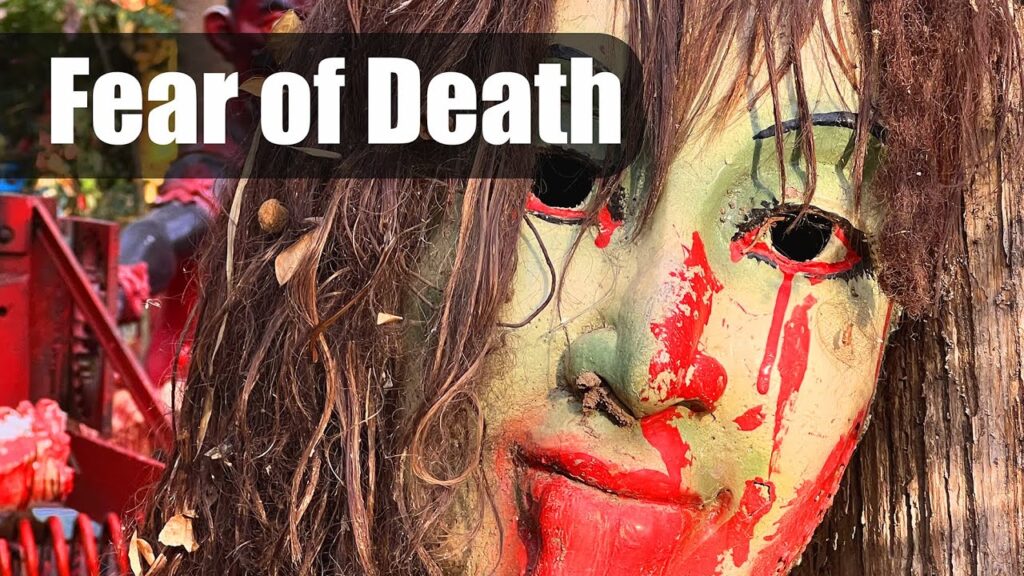
Today is the best moment to talk about death, says Hans, because we are still alive in this human form. Otherwise you might not be able to hear this message right now.
In this talk of about seventeen minutes, he invites listeners to look at the fear of dying with an open mind: the body as a vehicle, what near-death experiences suggest, why we fear one single event, and why the more useful question is not about death at all but about who we are beyond it.
In short: Fear of death is normal, Hans says, but death is a human judgment placed over the impermanence of all material things; the more useful question is who is aware of it all.
This is one person’s spiritual perspective, not medical or psychological advice. If thoughts about death weigh on you, please talk to a doctor or someone you trust.
Talking about death while alive
Hans starts with a caveat: we cannot really know whether we can talk about death after it happens. The conversation is only possible for those who choose to believe that we do not die but transition into something quite different from our usual human form. He points to people who have had a near-death experience, ordinary people with accidents or illnesses who were given a glimpse of “the other side”. In his humble opinion, he says, there is no other side: we have been, and will be for eternity, on the same side, and it is a matter of learning our true nature.
Why do we fear death?
Fear of death is absolutely normal, he says. Anyone whose life is threatened will react with utmost force, an instinct that protects us from leaving before our time. If we left before learning the lessons we came for, it would be a wasted opportunity. Life is also fragile: a bacterium, an earthquake or a flood can end it, which makes it a miracle that we are still here. Look at your own life and those around you, he suggests, and you will probably find stories of close calls.
Is the body a vehicle?
Hans offers an analogy. You use a car to travel from one place to another. Would you fear leaving it behind when it breaks down, or when you arrive? Even if you love the car, it eventually gets worn out and goes to the junkyard. Did you die when you left it? If the answer is no, the human form may be a vehicle, with a purpose, and when the purpose is fulfilled it can be left behind. What remains behind is the body and its stories.
To the objection “it is me”, he adds a scientific point: cells in the body are renewed over time, and he cites the popular figure of seven to ten years, so that you are not the same physical being you were a decade ago. The vehicle has been renewed without your awareness, so can we say you have already died at least once? It is worth knowing that the exact picture is more nuanced: tissues renew at very different rates, and some cells last a lifetime. But the underlying point, that our physical form is constantly changing, holds.
What leaves the body at death?
From a scientific standpoint death is the end of biological functions: no breathing, eating or moving. But does awareness stop? Hans notes that people who were clinically dead and came back have reported dialogues and visual details that should not have been possible. He encourages listeners to do their own research. And he asks a simple question: what is left when someone dies? There is a corpse, which moments before could speak, move, feel, taste, touch, smell, hear and see. “Something left that human form and went somewhere else.” Is that the mind, the personal memory, the soul? He invites us to investigate what that non-material part of human experience really is.
Why live in fear of one event?
Even if death were a final end, he asks, why live every day in fear of an event that happens once? He sees two ingredients to the fear: not knowing when it will come, and disliking the suffering we associate with dying. Would it help if someone promised you a peaceful death in your sleep at 108? He cannot make that promise, he says. Religious beliefs and ideas of an afterlife can offer real comfort, and he encourages exploring them as a better use of time than only seeking pleasure, which often means ignoring mortality altogether. Waking up to death can be painful, but exploring it intellectually can reduce the discomfort, and “you learn to die today” can even be liberating.
What sleep shows us about death
We are already familiar with something like it. Every night we go to sleep without fearing we might not wake up, drift into dreams that feel as real as waking life, and then into a void of deep sleep. Awareness seems to end, and the next day it starts again. The same pattern holds for things: a toaster comes into existence, serves for many days, then breaks. A great idea gets talked about, then changes or is abandoned. What they share is impermanence. Existence does not disappear, it changes form: even a corpse that is buried or burned turns into something else.
Who am I beyond death?
Hans’s conclusion is that death is not really a “thing” but a human judgment placed over the unavoidable impermanence of material things as they pass from one form to another. We experience all of it as observers, through consciousness and awareness. So the truly important question is not about death, it is: “Who am I?” If you can answer that for yourself, he says, he would love to hear your thoughts.