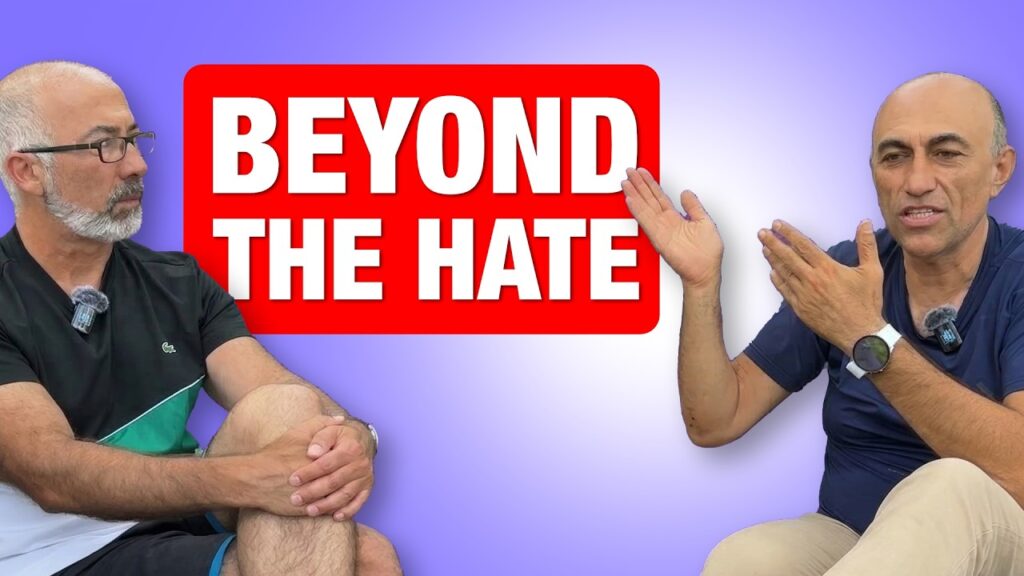
What happens to the heart when your home is threatened because of your faith, and a friend is eyeing your bike? In this conversation, a man who grew up in Iran tells Hans how his mother answered that question at thirteen, and how it shaped his view of religion, unity and love.
Hans sits down in the Philippines with Kave Shahidi, who was born in Iran, spent most of his adult life in the United States and now lives in the Philippines with his family, and with a friend of his, a dentist from Arizona who was born in East Africa. Both are members of the Bahá’í community. They are careful to say that they speak only for themselves, not for any Bahá’í institution, because the Bahá’í Faith has no clergy and encourages every person to investigate truth independently.
What follows is the personal understanding of the two guests, shared as one voice among many. It is not an official statement of the Bahá’í community, not a claim of proof, and not advice. If you would like the community’s own view, the guests point to bahai.org.
No clergy, and a duty to investigate for yourself
Kave begins with a caveat that runs through the whole conversation: in the Bahá’í Faith nobody holds the role of interpreter. Everyone has access to the same writings, and the practice is consultation, comparing what each person sees, since two people who sit facing opposite directions can see more together than either does alone. Faith, he says, is not a matter of inheritance. Young people are encouraged to declare for themselves at fifteen what they believe, and even then the invitation is to keep questioning. The Bahá’í calendar, he adds, even has a month called Questions.
A thirteen-year-old in Iran, and what his mother said
Kave describes how, as a boy in Iran, he saw neighbours’ homes burned and animals lost after someone blamed Bahá’ís for something, and how a friend of his talked about taking his bike. He says he felt betrayed and numb. When he finally told his mother, she asked whether he was hurt and then said that all those feelings were hate, and that hate is what had burned the houses down. She warned him to guard against the spark jumping into his own heart, where it would burn for the rest of his life.
That moment, he says, taught him to separate people from what they do: ignorance and hate are the enemy, not persons. He also states that Bahá’ís in Iran have suffered grave persecution since the faith began, and he mentions family members who were killed. These are his personal accounts and his own figures, and we pass them on as such.
Constructive resilience
He calls this attitude constructive resilience. Told as a student to sign a paper denying his faith in order to stay in school, he refused because the faith asks him not to lie, and he was expelled. He did not turn to violence or bitterness. His answer is to put the energy of being upset into something positive. He compares it to the teaching of turning the other cheek, which in his reading does not mean being weak but rising above hate.
Oneness is not sameness
Both guests return to the idea that humanity is one body. If you cut a finger, the whole body feels it, so harming another person is harming yourself. At the same time, the dentist is quick to say that oneness is not sameness. A community should include every colour, culture and background, and the goal is a unity that celebrates differences rather than erasing them. Kave offers the image of a school of fish, a community that moves together in harmony, with institutions that exist to support individuals and communities and not to dominate them.
They also stress the old story of the elephant described by people who can each touch only one part. Raise your consciousness a little higher, they suggest, and you can see the whole animal. Kave adds a memorable picture: after a dentist’s anaesthetic you have a numb lip you hardly notice, and when feeling returns there is tingling and some pain, but also the sense of wholeness. Humanity, he suggests, may be in that tingling phase of waking up to the pain of others.
Manifestations, mirrors and two wings of a bird
On the Bahá’í understanding, as explained here, the founders of the world’s religions are like mirrors reflecting the light of God, like the sun seen in a mirror, which is why Bahá’ís speak of religious truth as one, unfolding through successive teachers. Kave names Bahá’u’lláh as the central figure of the Bahá’í Faith and describes themes it emphasises: the equality of women and men, the pursuit of justice, and harmony between science and religion, which he calls two wings of the same bird. Religion without science, he says, can harden into dogma, and science without morality can be harmful.
Purpose, service and meditation
When Hans asks about the purpose of life, Kave describes three possible views: that we are just bones and molecules for eighty years, that we are that plus a higher intelligence, or that there is something more to us, spiritual and not visible. He holds the third and says the purpose is twofold: individual growth, which includes learning to love and to resist hateful impulses, and the shared work of building a better civilisation. His friend adds that seeing life through a lens of service, humility and gratitude has made his own life more fulfilling, and that this applies whether or not someone has a faith. Both say that if we quiet the noise and meditate, inspiration and invention can arrive.
What a Bahá’í community does
The guests describe simple community-building activities: gatherings for prayer from any tradition (or none), moral education for children, support for young teenagers, study circles, and social action. The point, they say, is not membership or conversion. Religion in this telling is more like a state of consciousness, a way of loving a culture so thoroughly that you belong to it without a passport, and it is expressed in action.
Do’s, not only don’ts
Kave remarks that religion has often been presented to the young as a list of don’ts, which can fossilise the mind. He would rather see it as a world of exploration, with a few real limits such as not hurting people’s feelings, and with questions treated as sacred. He hopes listeners will come away with fifty more questions rather than a set of answers.
A short reflection
Whatever one’s tradition, the story at the centre of this conversation is hard to forget: a young person hurt by injustice who is asked to notice that hatred has no owner but burns whoever holds it. Whether through prayer, inquiry or simple presence, many of the guests on this channel point to the same movement from separation toward the whole. Watch the full conversation above and tell us in the comments what you take from it. If you enjoy interfaith dialogue, you may also like Interfaith and Peace.