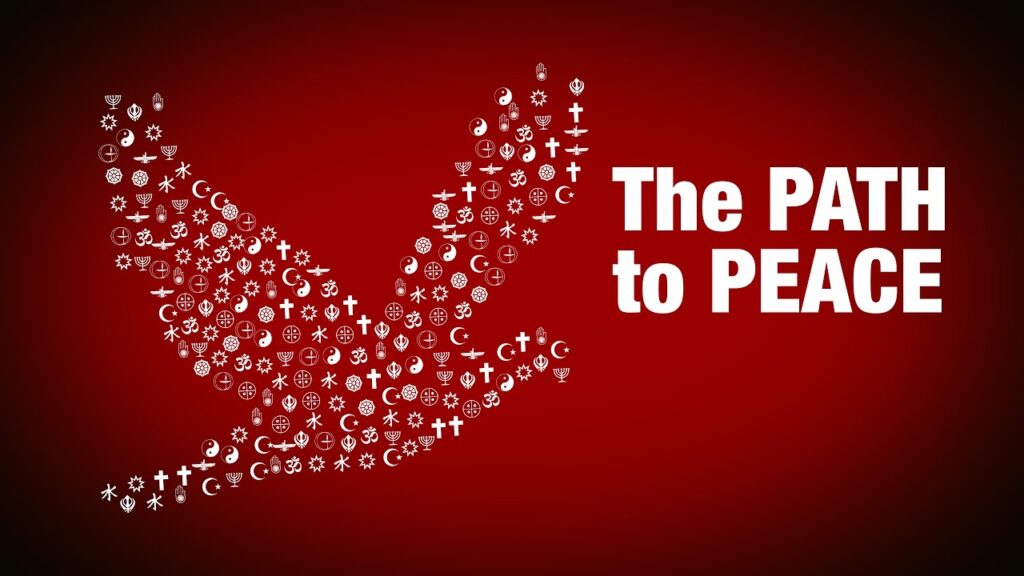
Hans grew up in a small village in northern Germany with about one hundred inhabitants, a place he calls good for cultivating ignorance about the outside world. Religion was present but rarely practised, other religions seemed like tales from far-away countries, and material security came first. This fifteen-minute essay follows how that picture changes once people meet each other, and what it could mean for peace.
Between his own reflections, the video includes short clips from an interfaith pilgrimage in Chiang Mai, where people from different traditions walk and talk together.
In short: Hans traces how trade and travel started interfaith contact, notes that today’s dialogue grew out of conflict and suffering, and argues that listening with kindness, rather than insisting on being more right, is the way to peace.
The historical overview below is Hans’s summary as presented in the video. We have not independently checked each date or claim, so please treat it as one speaker’s outline, not as a reference text.
A village, one religion, little curiosity
Most of us, Hans says, were raised in religious environments with minimal practice, taught to believe simply and to fear God. Profound questions received little attention. Almost everyone is born into some religion or belief system, and he sees no problem with that: religion shapes our fundamental values and can serve as a beneficial starting point for discovering our real nature. In his view there is no bad religion. Exposure to people of other faiths came only through travel, education and commerce.
How the conversation began
Hans sketches a history in which the search for material wealth is what first brought faiths into contact. He mentions the Persian Empire around 500 BCE and the merchants of the Silk Road, who needed respect and communication to do business across religious lines, and the Islamic golden age, when cities such as Baghdad, Cordoba and Cairo are described as models of coexistence among Muslims, Jews and Christians. He suggests that even the Crusades, for all their violence, indirectly fostered cultural and intellectual exchange.
The awareness of these benefits came much later, he says, and he names several milestones: the World’s Parliament of Religions in Chicago in 1893, the World Congress of Faiths in 1936, the founding of the World Council of Churches in 1948, and the Second Vatican Council of 1962 to 1965. He adds that 9/11 underlined the need for dialogue, and that grassroots initiatives, the internet and academic interfaith programmes now carry it on.
Two sides of the coin
Hans stresses that these developments emerged out of immense suffering: extremism, fundamentalism, political conflict dressed in religious language and disputes over exclusive truth claims. So he describes two sides. On one, communication and shared communities create peace and wealth and let people worship within their own tradition while learning from others. On the other, violence, injustice, greed and hate are justified in the name of religion. The root cause, he says, is a lack of communication and ignorance of religions beyond one’s own.
He asks what purpose it serves to insist on being more right than those who believe differently, and describes judgement as a barrier that filters perception through rejection. By taking a defensive stance, we lose the chance for meaningful dialogue and for recognising the shared humanity beneath our differences.
Voices from Chiang Mai
The pilgrimage clips add small, human moments. Walkers describe going from a mosque to a Lutheran church and feeling “really one” family. A statue of a Chinese compassion figure is said to look like Mary. A Sikh speaker explains the turban as a sign of respect for the Holy Scripture, the history of the sword, and the Gurus’ emphasis on equality of men and women. A Christian Orthodox speaker says that the first thing is to fight for peace from heaven and love on earth, and another participant simply says, “I need to learn from you.”
Practising a religion that unites
Hans closes with an appeal. Interfaith dialogue and understanding, he says, may be the key ingredient for peace, and the spark of truth comes from the clash of ideas, not of people. He invites listeners to be open-minded, to engage with those who seem different, and to remember that one divine source has inspired all religions. His final line is a call to create together a space for all living beings based on the highest human values, love and peace, ending with “Om Shanti Shanti Shanti.”
For a related theme, see the talk on whether morality really matters.