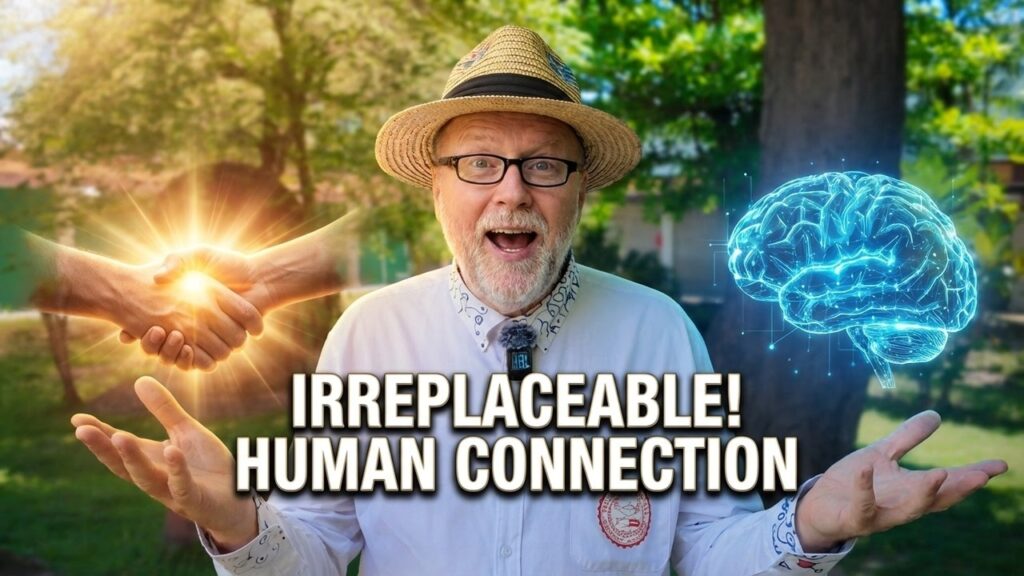
If machines can do more and more better than we can, what makes humans worth keeping around?
In this twelve-minute talk, Hans looks at the hunger for distraction, the economics behind the rush toward artificial general intelligence, and the question of human worth. His answer is short: our capacity to feel, and above all to love.
This is a personal reflection offered as one voice among many. It is not technical, economic or professional advice, and the claims about AI and about feelings are the speaker’s own views.
A thirst for distraction
New technologies feed a thirst for endless distraction, Hans says. Machines collect information about us and feed it back as polished content that is spectacular, urgent, beautiful or violent, anything that triggers strong emotion. That trains our minds toward ever shorter attention spans, and we start to speak and act as the machines have trained us. In this loop, he argues, creativity cannot flourish because the human aspect of being inspired is missing, and the whole system depends on other humans who “cook the pixel menu”. The tools themselves have no agenda unless humans trigger one: “a knife does not know how to cook”.
Money, power and no guardrails
The people developing these tools are mainly distracted by money and power, the speaker says, and they do not want to be questioned. He describes plans to take over the world as fast as possible, with the first to reach artificial general intelligence taking the crown, no guardrails, and economic interests as the driving force. He notes that a couple of thousand scientists have already rung the alarm but lack the economic backing to build oversight, and that stopping AI will take new ideas cleverer than AI itself.
Nature’s technology
The same technology presented as the saviour for humanity’s problems is causing problems on a gigantic scale, he says, while nature took billions of years to build a delicate balance. AI “can teach us how to make cheesecake but it does not provide such cake”, since nature supplies the ingredients.
What makes us worth keeping?
Hans poses the uncomfortable question directly: if AI does better than most humans, who are often undereducated, ignorant and driven by emotion, why should we value humans? His answer is the capacity to feel. We are able to love, to experience bliss, and to chase that state, and machines feel nothing. He says signs of compassion and compassion itself are not the same thing, and that if software appears compassionate, there is a human behind it amplifying their own compassion. This makes every human, even a self-centred narcissist, a feeling being who should be respected over a benign machine without feelings.
Three tasks
He describes three tasks for a short lifetime: to love, to be loved, and to learn to become better humans. The marketing charade that AI can fulfil these needs, if we pay for it, serves someone’s egoistic desires, he says. The talk ends with a reminder: “You are powerful. You are loved and you are never alone”, and that machines giving a false sense of company do not change that.
How to read it
This is an opinion piece rather than a technical assessment, and it cites no sources. Current AI systems can produce text that sounds caring, and whether they have any inner experience is an open question that researchers and philosophers disagree about; the speaker takes a firm position that they do not. The number of scientists who have raised alarms is not specified in the talk, and warnings by AI researchers range from concerns about misuse to concerns about loss of control. The claim that the technology emerged around five years ago is the speaker’s rough framing, since the field has a much longer history. The statement that love is given through divine grace is a spiritual belief.
Questions to take with you
How much of your attention goes to feeds built to hold it, and how much to people you could love? What would you defend if someone asked what makes humans worth keeping? Related talks on this site include Is AI Stealing Your Life? and Can a Machine Be Aware? Francis Lucille on the Chinese Room. Watch the video above and tell us in the comments where you feel the line between tool and companion.