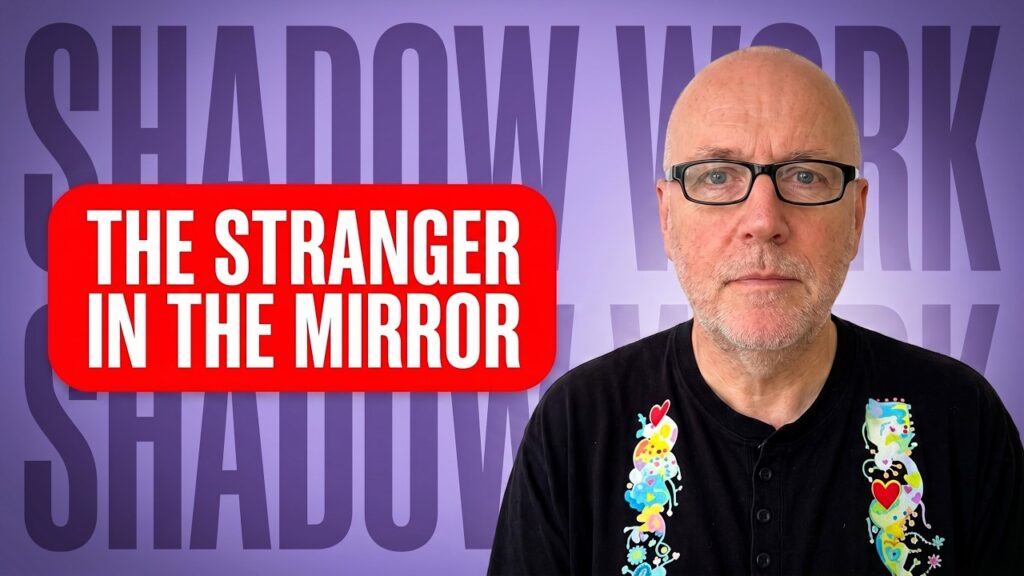
Have you ever snapped at someone you love and wondered who was talking?
In this fifteen-minute talk, Hans introduces shadow work: the practice of meeting the parts of yourself that you have pushed out of sight. He uses the image of a polished mask and a basement beneath it, explains the idea with Carl Jung’s psychology and a nondual picture of the witness, shares a story about a colleague he once judged, and offers three journaling prompts to begin. It ends, as many of his talks do, with “Om Shanti Shanti Shanti.”
This is a personal reflection offered as one voice among many. It is not psychotherapy, medical or professional advice. If shadow work stirs up painful memories, consider doing it with a qualified therapist.
The mask and the basement
Most of us, Hans says, build a persona, a polished professional mask. Parents, teachers and society hand us the blueprints: be good, be successful, be respected. We spend decades perfecting the version that is kind, hard-working and always has it together. Beneath it is “a basement”, a hidden room in the foundation of the psyche into which, since about the age of five, we have thrown every ugly thought, selfish impulse and shameful desire.
What the shadow is
The concept comes from the Swiss psychologist Carl Jung. In Hans’s telling, the shadow is not evil; it is simply the parts of your personality you rejected or judged unacceptable. His example is a loud, vibrant child raised in a house that said “be quiet.” To be loved and kept safe, the child cut those qualities off. Twenty years later the adult cannot stand loud, expressive people. The annoyance, he says, “isn’t about them. It’s just information that you’ve stored in your basement.”
He pictures the shadow as a heavy backpack dragged along for years, full of “rejected gold”: lost creativity, healthy anger (which often shows up only as an inability to set boundaries) and your most honest desires. “When we hide in the dark, we accidentally hide the light, too.”
The wave, the current and the witness
The nondual turn comes in the middle. You are not just the mask, and not even the basement. The persona is a small wave on the surface, the shadow a dark current below, and most of us think we are the wave. But there is also the silent witness, “the water itself”, the pure awareness that observes both without judging either. “You are the screen, not the movie.” From that seat, the shadow stops being a monster and becomes part of the scenery you can look at without flinching.
Finding it through your triggers
The way in is projection, a term from psychology for seeing in others what we have not owned in ourselves. Hans tells of a colleague he found insufferably lazy while he was the team leader, fuming about it every night. Years later, looking at his anger as the witness, he saw that he was not angry at the laziness. He had never allowed himself to rest, and his shadow was saying, “I want to do nothing for five minutes, too.” His judgment was a mirror. His advice: think of the person who is not dangerous, just rubs you the wrong way. “The irritation is a map.”
Three prompts and a cup of tea
You need a journal and a quiet room, and no hurry, because “the shadow doesn’t talk to people who are in a hurry.” Hans offers three prompts. First, write a fictional villain from your own worst traits, give them a name, and ask what their superpower is and why you secretly envy their freedom. Second, remember what you were most often punished or shamed for as a child, and notice whether you treat yourself the same way today. Third, list three people you dislike, write the trait they share, and ask how that trait exists in you, perhaps in a small, hidden or opposite form. The goal, he says, is not a conclusion but “to start a relationship.”
Then comes integration. You cannot kill a shadow; a brighter light only makes it sharper. Instead, invite it to sit down and have some tea, and ask a mean or aggressive part, “What are you trying to protect me from?” Usually, Hans says, it is a shell around a small, wounded version of you who once felt unsafe. The result is not becoming a good person but a whole one, someone who can be kind and also fierce, selfless and also able to say no without guilt.
How to read it
This is a popular, simplified account of Jung’s idea, told from a spiritual perspective. Jung himself held that the shadow can contain valuable as well as troubling qualities, which fits Hans’s “rejected gold.” The talk is an invitation to reflect, not a clinical method, and the journaling exercises are best treated gently.
Questions to take with you
Who irritates you most this week, and what might that person be carrying for you? What were you told not to be as a child? Related talks on this site include Empathy: The Key to Unlocking Your True Self, which also treats judging others as a reflection of our own limits, and Pleasure and Pain. Watch the video above and share in the comments what your own irritation pointed to.