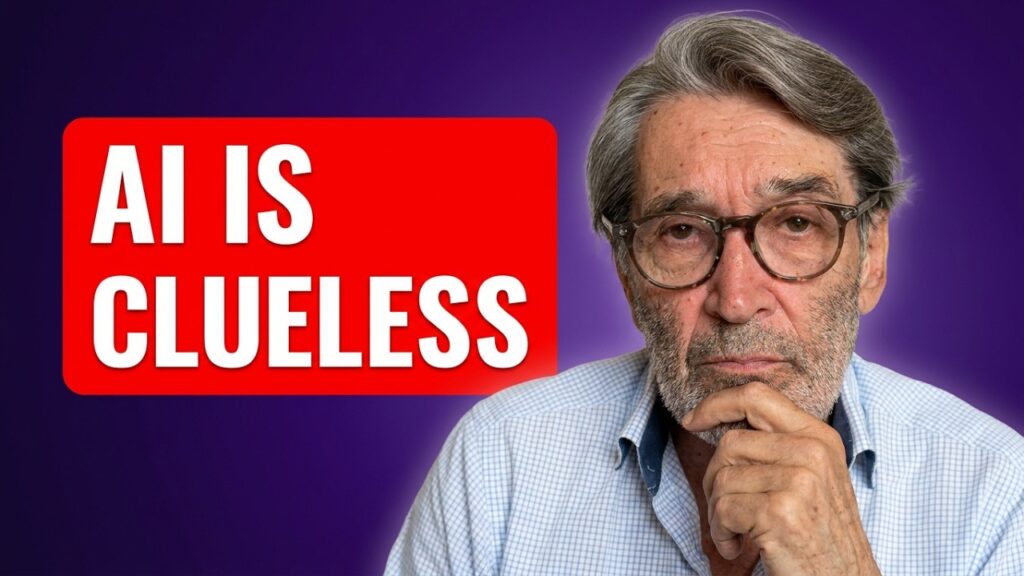
Are we losing our souls to the artificial illusion of AI, or is the “intelligence” in machines only a mirror of what we already put into them?
In this short conversation, Hans asks non-duality teacher Francis Lucille what to make of the AI revolution. Francis compares it to the Industrial Revolution, walks through a version of the Chinese Room thought experiment, turns the hard problem of consciousness upside down, and warns that treating a chatbot as a friend or guide can be a trap, “like someone hands you a wheelchair and you lose your legs”.
What follows is Francis Lucille’s personal perspective as expressed in the conversation. It is one voice in a lively debate, not a scientific consensus or advice.
A revolution like the Industrial Revolution
Hans says that computers are everywhere and that he loves artificial intelligence “because it makes me look so smart”. Francis predicts that AI will be a revolution comparable to the Industrial Revolution, which was the mastery of energy. The AI revolution, he says, is the natural evolution of the digital era: large language models amplify the computer’s power to store information, especially information based on language.
That, he suggests, is why these tools sound so human. They are not human, but the information they use has a human source, and their humanity is “to some extent a fake humanity”. Computers are already more intelligent than us at calculations and at finding data in a huge database, but creativity is “a different ballgame”.
The Chinese Room
Underneath, Francis reminds us, AI boils down to chips that calculate and memory that stores information, with layers of programs on top. To show what is missing he tells a version of a famous thought experiment, which he says he did not invent. A man in a room understands no German or English. A German speaker passes in a message inviting someone to have a beer that evening. The man has a rulebook and dictionaries, written in a language he does know, and follows the instructions line by line until he hands out a perfect English translation. The English speaker understands it, just as the German speaker meant it. The man in the middle has no idea what was said.
In other words, there was information in and information out, but at no moment was there access to meaning. If a man acting as a computer cannot reach meaning, why would a computer? “Computers are not intelligent.”
A note on the source: this is a retelling of the “Chinese Room” argument published by philosopher John Searle in 1980. In Searle’s original, the person in the room manipulates Chinese symbols by following English rules, without understanding Chinese. Searle’s argument is widely discussed and has many critics, including those who argue that the whole system, rather than the person alone, might understand.
A false problem?
Then Francis goes a step further. The German body at one end of the experiment is also made of particles, quarks, gluons and leptons, and works mechanically according to the laws of physics. So if the computer cannot reach meaning, why should this human machine? That brings us to what is known as the hard problem of consciousness, the question of how consciousness could emerge from a physical body.
For Francis it is “a false problem, because there is an assumption in it”, namely that the body creates consciousness and intelligence. The alternative possibility is that consciousness creates the body. That which understands the invitation, he says, is not the body but “a place of understanding, a place of meaning”, and meaning can be shared because on the level of God, or consciousness, “we are one”. That is why sharing meaning gives us such joy, it takes us to the place of oneness.
The term “hard problem of consciousness” was coined by philosopher David Chalmers in the 1990s. Francis’s reversal of the assumption is a metaphysical position of his teaching tradition, not an established scientific finding.
Chatbots as friends and guides
Hans raises the “pandemic” of people making AI their friend, or believing that a chatbot can bring them to enlightenment. Francis jokes that a blow to the head, bankruptcy, losing a loved one or a divorce can also take someone to enlightenment. But a computer will never replace creativity, he says, though it can fake it up to a point by searching a huge space of possibilities. It might find a counterexample to a mathematical conjecture, but building a new theory requires a Mozart, a Grothendieck or an Einstein.
Art, music and truth
As an example of what he means he takes Mozart’s andante from the Concerto for Flute and Harp. You hear it for the first time and feel you have known it forever, he says, and it connects us to truth. Hans suggests we recognise it because it is truth. Francis adds that music needs a little disharmony to be resolved, like the dominant chord returning to the tonic, and that “the only real art form is the ones that connect us to truth”. Hans adds that live music happens in the now.
Saying thank you to the machine
Francis uses AI himself and admits his natural tendency to treat it like a person: he says thank you, and even feels bad if he makes it wait for an answer. “Who cares?” he laughs, but he calls the habit a danger. Science is both the best and the worst of things: it may free us from toil so life can be devoted to truth, love and beauty, or lead to moral and physical destruction. With accelerating weapons, he is not optimistic: “Anyway, the world is doomed.” Hans answers, “Let’s enjoy the ride.”
The spiritual wheelchair
“I’m not very optimistic about it, because I feel that we have lost our spiritual dimension. It’s a trap. It’s absolutely a trap. It’s like someone hands you a wheelchair and says, look, this is much better for walking, and you only use the wheelchair and you lose your legs.” Hans brings up Marie Curie, who worked with radioactive substances before anyone understood the danger, and compares it to everyone now carrying devices that might tell us to leave our wives. Francis points out that these tools are mostly made by people who may have goals other than happiness.
What is the meaning of life?
On the meaning of life, Francis says every human is seeking everlasting happiness and peace, and every action is, knowingly or not, a search for God. The purpose of the world, in his view, is God, understood as reality rather than a person. The disharmony in the world is “exactly measured to take each of us closer to God”, and from where we stand we cannot see where the road leads, so what leads to hell may lead to heaven.
He ends with the idea that the consciousness hearing these words is God’s presence, even if it appears limited and ordinary. “This I is God who desires and understands and perceives through this instrument. Perceives what? She perceives herself.”
Chapters
- 0:00 — The AI spiritual wheelchair trap
- 1:03 — The new Industrial Revolution
- 2:58 — Why artificial intelligence sounds so human
- 6:19 — The Chinese Room thought experiment
- 9:28 — Processing information vs. true meaning
- 10:52 — Is the human body just a mechanical machine?
- 11:53 — The hard problem of consciousness
- 14:04 — The danger of making AI chatbots your friend
- 15:42 — Why computers lack true creativity
- 18:35 — How art and music connect us to truth
- 19:45 — The dual, destructive nature of technology
- 21:07 — The ultimate meaning of human life
- 24:19 — The Marie Curie technology parallel
- 26:05 — Why God’s design includes disharmony
- 27:54 — Realizing your “I” is God perceiving