What happens after the glimpse, when the world reappears and the body reappears and life carries on as before?
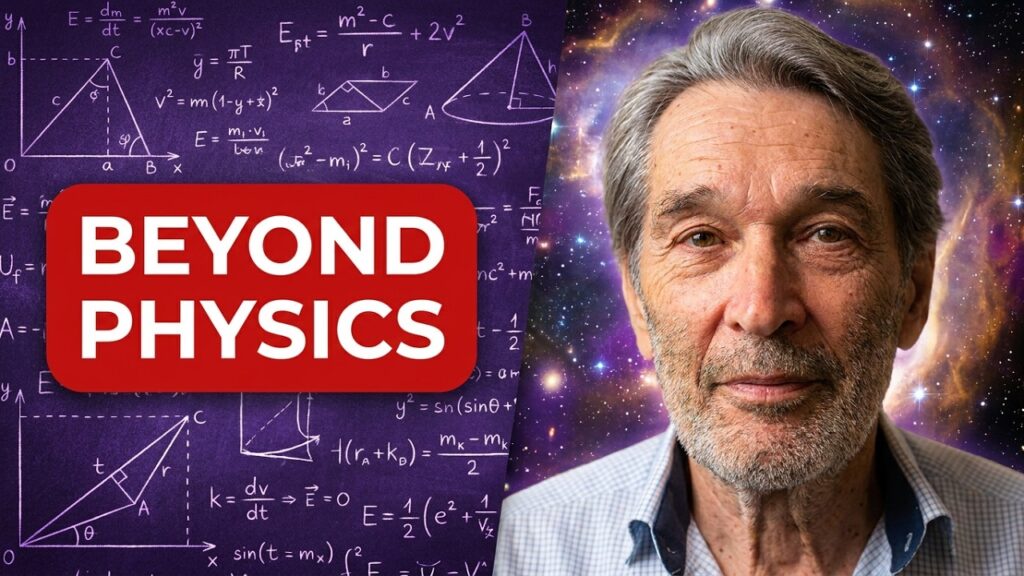
In this conversation, Hans talks with Francis Lucille, the non-duality teacher who was trained in mathematics, physics and space engineering before meeting the spiritual teaching of Krishnamurti and, later, his own teacher Jean Klein. They talk about whether a lineage is necessary, the difference between a mystic and a sage, the progressive and direct paths, why a glimpse needs to be planted in “the garden of life”, and what true devotion and education could look like.
What follows is Francis Lucille’s personal perspective as expressed in the conversation. It is one voice among many, not advice.
From testing missiles to spiritual teaching
Hans opens by noting how dramatic it sounds that Francis once tested missiles. Francis gently corrects the picture: he is not a professional physicist, he was trained in mathematics, physics and space engineering, and he did test missiles, but only for about four years. He stopped very early, when he came across Krishnamurti’s teaching, which was not in favour of weapons, and went on to hold various jobs with the French government, none of them military. He has followed physics and mathematics from a distance ever since.
His own story, he says, began with psychological suffering. By a young age he had “checked all the requirements” that society and his parents had taught him for happiness, and he was still suffering. That started a quest for meaning, even for God, though his parents were atheists and he himself a “tough cookie” with a hard-science background. Krishnamurti was a good introduction, since he said not to trust religions while having mystical experience himself. Francis then turned to Buddhism, Advaita Vedanta, Taoism and Zen, and, with a classical education in Greek, Latin and German, saw connections between Socrates, Plotinus, the pre-Socratics and Eastern philosophies. “Buddhism is a godless religion.”
Jean Klein and the question of lineage
“As they say in India, when the disciple is ready the teacher appears.” Francis’s teacher was Jean Klein, with whom he spent about twenty years until Klein’s death. Klein came from an Advaita Vedanta tradition and had met teachers in India, also studying Kashmir Shaivism and hatha yoga, so the teaching stood at the crossroads of three traditions while recognising all religions.
Is a lineage necessary? Francis points out that authentic teachers such as Ramana Maharshi apparently had no known lineage, though perhaps Ramana had met someone who briefly “transmitted the flame”. He says he does not know the answer in theory. For Hans, the question is moot: “This question has already been answered through our meeting. You have already met the tradition.” Hans calls it divine grace, something you cannot control.
The point of no return
There is a moment of no return, Francis says, but it may not feel like one. It may simply feel like “oh, that makes sense”. People may then live as if nothing had happened, but “the virus has gone into the system” and takes time to do its work. Others have a big experience that does not free them from the belief in being a separate entity.
The mystic and the sage
This is where Francis draws a distinction between the mystical experience and what India calls mukti, liberation. The mystic has a revelation of God but remains unclear about the nature of the connection, so afterwards they know God exists but still feel they are a separate soul. In the liberating experience, “there is a revelation that as a person, the person I believe to be doesn’t exist; only God exists.” He links this to the Sufi word fana, extinction, in which the sense of being a separate person disappears. Every sage is a mystic, but not the other way round, because the mystic remains a mystic until they realise there is no mystic. In fact, he says, there is only one sage, which is God.
Can you lose it?
Hans has met people who had a glimpse, saw the light or felt they were the tree, then went back to ordinary life, and others who are clearly “really in it”. Does it have to be anchored? Francis answers that when you ask who could lose it, the question points back: God cannot lose herself, but she can play the game of losing herself, since otherwise she would not be almighty. What she cannot do is be anything other than herself, because there is nothing else to be.
The seed and the dark room
You do not need to understand everything, Francis says. If at some point you say “oh yes, that’s true, that’s my experience”, that is the seed, and it develops from one understanding to the next. He uses the old darkroom image: after the glimpse comes the developing, as the picture gradually appears out of the white.
In hindsight it seems that suffering fades gradually, though in fact there are moments of freedom followed by relapse into ignorance and “the heaviness” returning. But the glimpse comes again, and the relapses become less frequent and shorter. The real difficulty, he says, is that people do not trust the glimpse and do not apply it in their lives. “It takes time to put your money where your mouth is.”
The keystone and the progressive and direct paths
Are there cases where it is instant? Francis tells the story of a yogi who was already very pure through practice and recognised the truth on hearing his guru: like the keystone of an arch, the last missing piece, after which the scaffolding can be removed. Others have not started building the arch yet. Even Ramana Maharshi, he notes, had a powerful glimpse, did not know what it was, spent years in temples and in a cave on Arunachala, and only then met the scriptures and understood. So there is progression, even though everything is given from the beginning.
This is the distinction between the direct path and the progressive path. On the direct path you receive the seed first and must tend the plant; on the progressive path you prepare the ground for ages until a grown plant arrives. The result is the same.
The Ferrari in the garage
Hans mentions teachers who promise instant satisfaction. Francis sees a risk in having no teacher: you may get a true glimpse, think “that’s it”, and not know what to do with it. His teacher compared such a person to someone given a Ferrari who leaves it in the garage, unable to go to the beach. The role of a teacher is twofold: to give the glimpse to those who truly desire it, “through a smile, even without words”, and to help them plant the seed, first in pots and then in the garden, which is our life.
Asked why he teaches, he says it is not necessary to become a teacher after realising, “otherwise there would be only teachers”. It is a vocation, like being a musician, and he is simply a joyful communicator who has also taught physics, mathematics, tennis and skiing. “When we share understanding, at that moment we are beyond the body, beyond the mind. We are God in this moment.”
Three ways up the mountain
How do we reach the experience of oneness? As a separate person, he says, I am nothing, but as my reality I am everything. We can go through thought, noticing that what perceives is not an illusion because an illusion could not perceive reality. We can go through feeling, as with the poetry of Rumi. And we can go through perception, asking whether we perceive the world and the body in accordance with what we have understood. Traditions put the emphasis on different sides, like ascending the same summit from various slopes.
Life parachutes us at different places on the mountain, so the aim is to be a well-rounded climber. He links these to the Socratic triad: the good, which belongs to feeling and love; the true, which belongs to concepts and understanding; and the beautiful, which belongs to perception. The teacher can take a student who knows one side to the others, so the philosopher also develops love and beauty, and the lover also develops clarity.
Devotion that is not a sacrifice
Asked whether he is devotional, Francis says he has devoted his life to truth and beauty, and that it was never a sacrifice. “We don’t cut deals with God.” If you give up comfort in the hope of getting a hundred times more after death, you are an investor, not a devotee. The true devotee has had it chosen for them and does it with infinite pleasure, like the artist whose reward is the painting itself, not the payment afterwards. Devotion can show up as being an artist, a doctor, a gardener or a parent; the sign is being happy in what you do, “without afterthought, without fear”.
Enthusiasm and the failure of schooling
Francis says children should follow their enthusiasm to the end, because then they discover the endlessness beyond it. He imagines Mozart forced to become a mathematician. School, he argues, aims at making “servants of the state and servants of the corporations, not happy children”. He would send a young child to school only to play with other children, and explore the world together with him through AI, asking each day what they are interested in. Hans likes the word “together”, since there is a human aspect in it, and shares how his own students are “forced to watch my videos”. Francis adds that great teachers awaken a dormant talent, and compares it to the way a meeting with a monk can change someone bored by Sunday school.
What conversion really means
The conversation ends on the word conversion. It is not, Francis says, converting to a faith in order to marry someone. Real conversion is: “I was lost, now I am found.”
Chapters
- 0:00 — The real goal of modern education
- 1:05 — From testing missiles to spiritual awakening
- 3:04 — The root of psychological suffering
- 4:27 — Discovering Eastern philosophy and Advaita Vedanta
- 5:46 — Meeting the spiritual teacher Jean Klein
- 7:38 — Is a spiritual lineage really necessary?
- 9:42 — The point of no return in awakening
- 10:51 — The difference between a mystic and a sage
- 12:24 — The illusion of the separate self
- 15:21 — Nurturing the seed of spiritual understanding
- 19:23 — The progressive path vs. the direct path
- 23:44 — How to reach the experience of absolute oneness
- 27:24 — Why true devotion is never a sacrifice
- 31:16 — Why traditional schooling fails children
- 36:40 — The real meaning of spiritual conversion