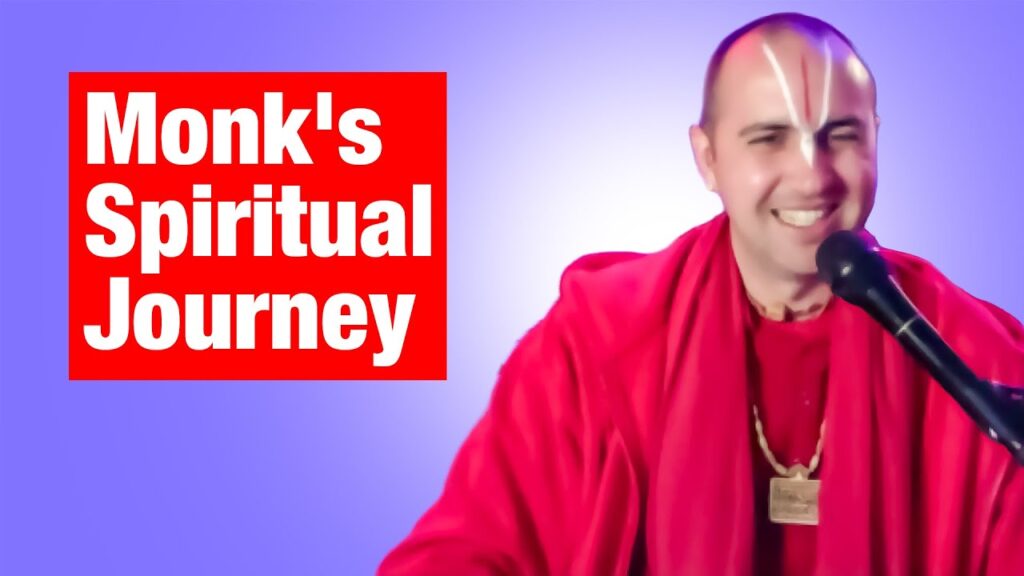
What happens when a working jazz musician with a comfortable life meets a spiritual master and decides to become a monk?
Rishi Aaradhakananda is a monk in Bhakti Marga, an organisation founded by Paramahamsa Sri Swami Vishwananda, and coordinates its music department internationally. In this interview he tells his own story, explains what the title “rishi” means in his tradition, and shares his views on mantra, guidance, devotion and even artificial intelligence.
What follows is the speaker’s personal perspective as shared in the conversation, including beliefs about karma, souls and gurus that we do not endorse or dispute here. It is not medical or psychological advice, and we share it as one voice among many.
A prayer, and who he is
He begins with a Sanskrit prayer of gratitude to the guru who opened his eyes “with the torchlight of knowledge”. Born in Brazil into a family open to spiritism, with Christian and Japanese influences, he became a Kriya Yoga practitioner in the Yogananda lineage as a teenager. In 2007 he moved to Germany to study music, and in 2011 he met his guru.
What a rishi is
In the monastic hierarchy he describes, there are brahmacharis, rishis and swamis. Rishi means “seer”, and in his organisation the role is to support the relationship between devotees and the guru and to teach. He is careful to add that nobody should assume the title means enlightenment: they are on the path like everyone else.
Success, and a missing point
Before becoming a monk he played jazz, taught around forty students a week and lived what he calls a good middle-class life. Still, he admits a feeling inside that something was missing, and that he was never quite at the very top of the field.
The living guru
He had always thought his guru was Yogananda, who left his body long ago. Meeting a living master taught him, he says, what an incarnated teacher can give that a non-incarnated one cannot: discipline and humility, a person who keeps you grounded instead of letting you fantasise your way along.
Loss and a turning point
He speaks openly about the loss of his baby daughter, who was born with a serious heart condition and died at six months, and says this period shaped his decision. When that chapter closed, he felt he could either restart his old life or begin a new one at his master’s feet. Having already seen his worldly wishes fulfilled before thirty, he chose the second. He describes a fear that he would be given work unrelated to music, and says that when he let go of chasing fame, devotional music videos with millions of views came without expectation.
Intention and the holy name
The difference between devotional music and any other, he says, is first the intention: following the Bhagavad Gita, it is not what you do but how, offering the fruits of action to God. Second, it repeats the name of God. Many traditions, he notes, including the Psalms and Sufi saints, speak of the power of the divine name. In his tradition he sees no difference between God and God’s names: “it’s like you have the phone number of God.”
Mantra and the mind
He cites the Gita’s teaching that the mind is a best friend when controlled and the worst enemy when it is not. Mantra and breathing practice, he says, are tools for that, and OM is considered the first, continuous vibration. As an opinion within his tradition he adds that Sanskrit sounds carry a special vibration.
Spirituality, religion and one Supreme
He defines spirituality as rediscovering your connection with the Supreme, and religion in its original sense as reconnecting, as distinct from dogmatism. He argues that Hinduism is often misunderstood as polytheistic: there are many forms and aspects, but one supreme God. He also says he has come to see that claiming all religions are the same has caused more problems than accepting real differences with love, which is why he values interfaith study.
Humility, helplessness and “same in quality, not quantity”
Where Advaita teaches “I am God”, his Vaishnava tradition, he explains, sees the soul as part of God: alike in quality but not in quantity. He values a kind of humility and helplessness before God that he finds also in many Christian saints.
Guidance and intuition
He thinks everybody needs guidance, as with learning to drive, and urges caution about online fortune-telling and “anybody on the internet”. His signs of an authentic master are subjective ones: a slowing of the mind and an absence of doubt in their presence. Intuition matters, but we must learn it, because the mind often calls “intuition” what it wants to believe. His practice is to observe the mind daily and recognise you are not the mind.
Knowledge, devotion and service together
On the old debate between studying scripture and simply calling on God, he says devotion is the more important, knowledge grounds it, and they complement each other. Emphasise what comes naturally, he suggests, but taste everything and surrender your actions to God.
AI and spirituality
He is frank that he does not expect good outcomes in a material sense if AI concentrates wealth, yet spiritually he advises: do your best, do not worry, and trust. He uses a Google tool to study a Vedanta book. According to his guru, as he relays it, machines will remain soulless, and the human body is a unique platform for spiritual realisation. These are beliefs from his tradition, not claims we have checked.
The gift of human life and a closing call
He closes with gratitude for human life and for Earth, and with a call to open the heart. In his words, real happiness is waiting on the other side of humility. He also invites listeners to visit the ashram near Frankfurt.
Chapters
- 0:12 — Introduction: Rishi Aaradhakananda of Bhakti Marga
- 1:12 — Early path: Kriya Yoga, music and meeting his guru
- 2:13 — Becoming a monk: the role of a rishi
- 8:16 — The living guru: discipline and humility
- 9:26 — The path to renunciation
- 13:08 — The power of sacred music and the holy name
- 18:24 — Mantra for controlling the mind
- 20:42 — What is spirituality?
- 23:34 — Hinduism’s monotheistic core
- 28:48 — Guidance from a true master
- 32:11 — Wisdom and devotion
- 35:20 — The path of surrender
- 37:24 — AI and spirituality
- 46:11 — The gift of human life
- 49:15 — True happiness and a final call