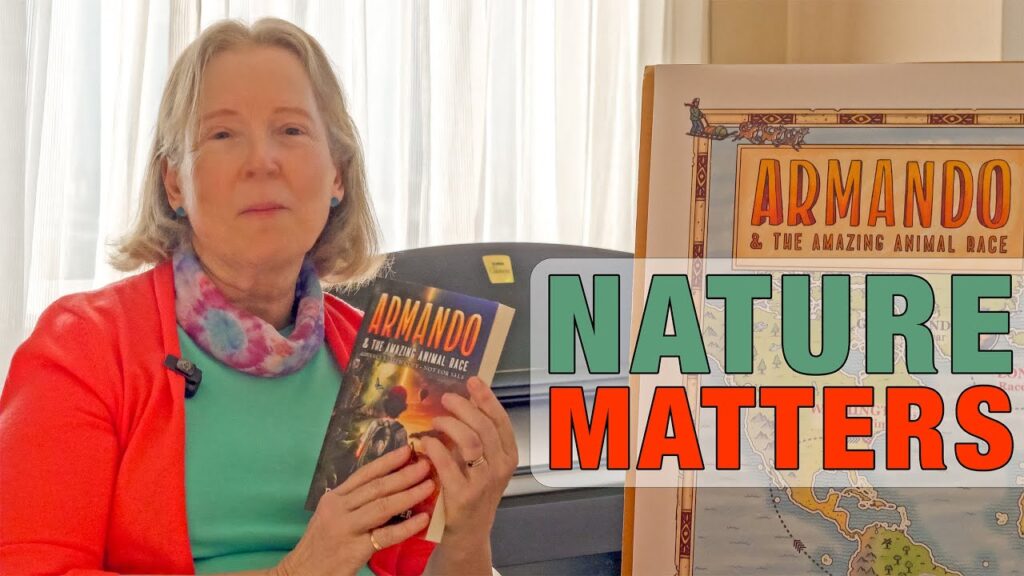
How do you get children as excited about the real world as they are about imaginary ones?
In this interview of about twenty-one minutes, Hans speaks with Diana Schaffter, author of the children’s book Armando and the Amazing Animal Race. She describes her path from science and public health to teaching and writing, the loss that gave her the idea for the story, and why she hopes young and old can learn from each other.
This is a personal conversation offered as one voice among many. Diana speaks for herself and her own book, and nothing here is professional advice.
A long road to becoming a writer
Diana says she always had stories inside her, and that her grandmother once told her she should write children’s stories. Her working life took another route. She began in biology, inspired by Jane Goodall, then chose public health because she wanted to help humanity and travel. Later she trained as a teacher and, as she tells it, opened a school on the Thai-Cambodian border and followed her husband, who worked with UNICEF, from country to country. She has now lived in ten countries.
Why a book about the real world
Working as a teacher, she noticed that many of her pupils, from all over the world but often North American, knew little beyond their own country. As phones entered children’s lives, she says, kids knew more about mythical animals and made-up places than the real animals and places around them. She wanted a fast-paced, exciting adventure rather than a dry, lecturing book. Her character Armando travels to countries he has never seen, makes mistakes and assumptions, and the reader learns alongside him without being preached at.
The loss behind the story
Diana speaks openly about the event that pushed her to write. Her mother, a former airline hostess who wanted her children and grandchildren to know the world and its animals, died in a tree fall at a monarch butterfly sanctuary in California, after pushing her grandchildren out of the way. Diana says it took many years to work through the grief. The book is dedicated to her mother and her husband, and the grandmother in the story, Granny D, was inspired by her mother, though she stresses that the characters are not copies of real people. The idea for the whole story, she says, came to her on a road trip while she was thinking of her mother.
Listening to readers, keeping her own voice
Diana describes sharing the book with conservationists, sensitivity readers from different countries and religions, and twenty-two children aged nine to fifteen. She says she had to learn not to follow every suggestion and to trust her own intuition, even when impostor feelings crept in.
Unity, stewardship and hope
She sees nature as more than a backdrop and believes people are stewards of the earth. Caring for something beyond ourselves, she says, teaches responsibility, compassion and patience. Two messages appear on butterflies in the book, “we are one” and “look for the good”. She hopes finding the good in each other can build bridges toward unity and peace. She also tells of searching with her husband for endangered animals, and of learning that the small group of desert leopards they had heard about in Israel had become extinct, which, she says, shocked and motivated her.
Diana finds hope in the children she interviewed, and in generations working together, mixing old and new ideas, as Armando and his grandmother do as a team. She invites listeners to look to her website, where she says there are resources, maps and a newsletter.
How to read it
This article is based on auto-generated English captions, so some spellings and details may differ from what was said. Diana’s views on stewardship and unity are her own convictions, and this is a conversation about a book rather than a review of it. Other guests on this channel see these questions differently.
Questions to take with you
Which real place or animal near you could you get to know better this week? What could you learn from someone a generation older or younger than you? Related talks on this site include Interfaith and Peace: From the Silk Road to Chiang Mai. Watch the video above and tell us in the comments what you took from it.