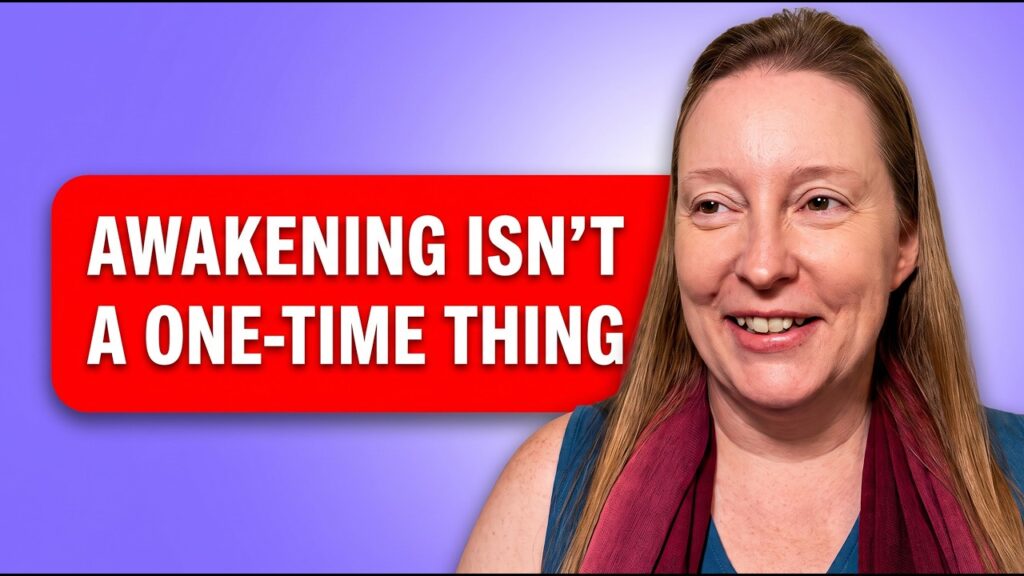
What if awakening is not one dramatic flash, but a seeing that has to be repeated until it becomes clear?
That is the experience of Helen Hamilton, a non-duality teacher and mother of four who spent most of her twenties in depression before a first, expectation-free meditation opened something she has been following ever since. In this conversation with Hans, she talks honestly about doubt, why practice still matters even when “you are already that”, and how everyday life is where awakening actually shows up.
What follows is Helen’s personal perspective as shared in the conversation. It is not medical or psychological advice, and we share it as one voice among many.
From depression to a first taste of bliss
Helen’s story begins around the age of 21, when a deep depression set in and lasted most of her twenties. Looking back, she says she was searching for fulfilment in the things life offered (parenthood, a relationship, a business) while something was missing the whole time, with a constant background fear of being “a fake or a fraud”.
Meditation was one of the things she tried to help. The very first time she sat, she says, she had an intense bliss, with no idea what she was doing. She was hooked at once, and it set her off on a search for what she had tasted. It took years before that became a stable recognition of who she is, along with “a lot of letting go of old ideas about myself”.
The value of not knowing
The second time she meditated, she expected the bliss to return. It didn’t, and she was simply angry for the entire sitting. Helen sees this as a lesson she has carried ever since: the first time she was desperate and embarrassed enough to hide in her bedroom, with nothing to lose and no hope pinned on it.
Over the years, meditation taught her that every session is different, and that the quicker we let go of ideas about what is supposed to happen, the sooner peace and joy arrive. “There’s no such thing as a good or bad meditation. There’s just what happens today is what was supposed to happen today. If that’s anger, so be it.”
Awakening while raising four children
Hans points out how unusual it is to hear about awakening from someone with a busy family and a business. Helen admits she struggled with believing she had no time, with very young children around. But in some ways it helped: because she had so little free time, she had to make the most of it when it came.
Her conclusion is one many parents will recognise. “We always tell ourselves we need more time than we have. But it’s how we use that time and where we’re coming from with our intention.” If devotion to truth is in the heart, even the smallest amount of time has a massive impact.
What does “awakening” actually mean?
Helen is careful about the words, since both “awakening” and “enlightenment” are used in many different ways. She can only share her own experience: a growing recognition that she is not just this body and mind, and that she is something much larger, “something without a form”, which does not come and go. She is also this body and mind, just as everyone is.
For her, awakening has two sides that go together. One is seeing who we really are, again and again, until it becomes clear. The other is seeing who we are not: noticing that a painful feeling inside comes from some old idea of who we thought we were, and that this idea turns out not to be true. Beliefs like “I’m not good enough”, “there is something flawed about me” or “I’m not safe” are, as she puts it, fundamental to a personality that thinks it is separate.
Doubt is healthy, so turn it into questions
Hans admits that when he interviews people who claim to have awakened, he still carries a bit of doubt. Helen welcomes that. She says she is “just like everyone else”, and that anything which has been realised is possible for everyone. One of the big ideas to overcome today, she believes, is that awakening is only for a few people who can leave their jobs and head for a mountain.
She calls doubt protective, a way of making sure we do not get involved in something inauthentic. Her own approach was to engage with the doubts directly: is awakening even possible? Is it safe? Will I still care about my children and my life afterwards? The mind is good at producing doubts, and we can simply turn them into questions and sit with them.
I always wanted to experience something myself, so that it wasn’t something another teacher was telling me. It was my own experience that I could prove to myself, so that then the doubts began to leave.
She recommends this kind of experiential proof to everyone, and says that when it happens, the doubts begin to fall away.
The moment she saw there was no one inside
Asked whether there was a before and after, Helen describes the first time she truly engaged in self-inquiry and had a direct seeing that there is no someone living inside the body. She had always believed in a central character in there, so completely that it was the focus of her life. Even awakening was her awakening, and she wondered how it would affect her life.
It was a shock to see that there was no one there, only a formless emptiness or consciousness running the whole show. It was exciting, because the problems of that supposed person began to fall away, but also shocking, because it was so different from what she expected to find. After that she could no longer lie to herself with the same conviction, even though she still did for a while. And when Hans suggests the experience may have found her rather than the other way around, she agrees: “Despite my resistance and despite my doubts and fears and feeling unworthy of it, it happened somehow anyway.”
Religion, mystics and an open door
Does belonging to a religion get in the way? Helen says religion is helpful at first and, like any aspect of human consciousness, has parts that are more and less helpful. She points to the Christian and Sufi mystics as people who wake up within organised religion, pushing its boundaries a little.
She had little connection to Christianity as a child, but after her awakening deepened there was “an allowing back in of everything that maybe had been excluded”. Going to church with her father, who was struggling with his health, she found the devotion there palpable and beautiful. For her the question is not the religion itself, but our attitude: am I willing to question some things? Some religious texts even start making more sense after awakening deepens.
Not a “game over” moment
When Hans asks whether it was game over with no more doubts, Helen laughs. Each seeing of who she really is took away some of the doubt, she says, like chopping pieces off an iceberg until the rest fell away. It was gradual, because the habit of going back to the old way of thinking is so strong, and we have practised it all our lives.
She calls the idea of one big moment after which everything is finished “a huge myth about awakening”. After her first self-inquiry moment, she spent two or three years looking again and again and being willing to question old ideas. She hasn’t seen anyone get away without that process. Nor, she adds, would she want one big moment: “if I have to get up for work the next day and take the kids to school”, a gradual path gives time to adjust as our view of ourselves changes.
And it never really stops. Even that morning, she says, her practice brought an even deeper, clearer seeing. The difference now is that when an old idea comes up, there is no resisting and no suffering in it, just a “wow, look at that, I didn’t know that was still in there”.
Radical non-duality versus practice
Hans mentions that some teachers, who call themselves radical non-duality, say there is nothing to do and that you simply wake up, with no lineage and a “point of no return”. Helen is gracious: “If it works for them, that’s great.” But her own experience, and her experience working with many students, is that regular, consistent practice is needed.
Her reasoning is simple. In one way, no practice is needed to be what we already are. But practice helps remove the obstacles to seeing it clearly: “If this is what I already am, how do I stop being what I’m not?” Meditation, contemplation and self-inquiry were her tools. She has seen many people get stuck in a mental understanding without living from it, and her deepest prayer was never to get stuck in the middle of the process.
Discipline, devotion and the shared root of two words
Hans confesses that discipline is not his strength. Helen reassures him: nobody she knows who set out to meditate every day succeeded straight away. She herself needed eight or nine fresh starts before becoming consistent, and only because the suffering got bad enough to make the desire to change stronger than the resistance.
Her explanation is kind. Two habits are battling each other, the old habit of believing in a separate self and the new habit of practice, and the old one has more momentum for a while. Missing days does not mean you are doing something wrong. “A little bit of understanding and self-love with that is really helpful.” We rarely hear about this stage, she adds, because we only see people who are already consistent and think we should be able to do the same straight away.
Helen, who calls herself a bit of a nerd about words, also points out that “disciple” and “discipline” share the same root. (They do: both come from the Latin discere, “to learn”.) For her, it comes down to where our devotion comes from. If we truly want the truth, forming new habits gets easier every day.
Using suffering as fuel
For listeners who are in a hard place and quick to judge themselves, Helen has a practical suggestion. Whenever she realised she had dropped her practice, or when something in the family triggered her, she could get angry and determined: this is one time closer to never feeling this way again. It was “fuel for the fire, literally.”
If we are going to suffer for a while, she says, we can use that energy for something, and turn it into devotion. If suffering has any purpose, it may be that it makes the desire to wake up stronger, until that desire translates into daily habits. She has also noticed that when she misses her morning meditation, she feels pulled here and there for the rest of the day, while on days she sits, challenges still appear but seem to resolve themselves more easily.
“There’s nothing to do”: the paradox of doership
Hans raises the paradox that many teachers say there is no doer, and that this could be misread as “I can’t do anything, so I don’t have to.” Helen says she misunderstood it too. At first it was a relief: I’m tired of trying to fix all these problems.
Eventually she realised that formless consciousness, by its nature, does nothing. It has no hands to pick anything up. But when it appears as a human being, it can do a lot. The actions of the body are informed by consciousness rather than by an old idea of being limited, so everything feels like it is unfolding effortlessly, with the body playing its part. Paradoxically, consciousness is “doing nothing at all” and “doing all of this” at the same time. It is silent and it is making sound. The mind finds this frustrating because it wants a linear yes or no.
Why separation at all?
Hans jokes that consciousness is a good joker: if there is only oneness, why go through all this? Helen says it made no sense to her for the longest time. Her current view is that in human form we have the capacity to think about what we are, and we mistakenly identify with the body at first.
She sees the whole universe as the expression of a divine wish to recognise itself, as shown by this very conversation. It can be an amoeba or a fish, but in the human form it can ask the big questions: where did I come from, what happens when I die, what is the point of all this?
And does our hard life experience have value? Absolutely, Helen says. The experiences that bring us to awakening, and the skills we have learned, carry over and become part of what each body-mind is here to do. That may look like a sage teaching, but hardly ever does. More often it is the person at the bank who smiles and asks how your day is going.
Collective awakening and real change
Hans brings up world leaders and the news: if oneness is real, what are we to make of all this? Helen says some people are still very lost in the idea of separation, and we see them on the news every night. She would love the news to be wider, to include stories of what happens when people begin to recognise who they are. She mentions reports about group meditation affecting crime rates. (These studies are contested, so treat that as Helen’s view rather than settled science.)
Hans shares his own experience of interfaith pilgrimages in Spain, Thailand and the Philippines, where people walk from one religion to the next, share food and talk about daily life. Helen loves this. “To me, that’s how real change is going to happen, rather than waiting for political leaders to suddenly have a change of heart.” Ordinary people changing how they interact with one another, she says, is how any real change has happened in history.
An eclectic path: singing, kirtan and everything that helps
Helen includes everything in her own teaching, including a monthly kirtan, because she loves to sing and chant. There were periods in her own journey when she could not meditate or do self-inquiry, but could sing along to a mantra, listen to talks on Meister Eckhart, or enjoy Sufi dancing and the poetry of Kabir and Rumi.
She had no lineage, which meant both benefits and drawbacks, but also the freedom to try everything that worked for her for at least ten years. Her advice is to have a few practices you can commit to regularly while not excluding anything else. If emotion makes meditation impossible in a given moment, a prayer or a bhajan can bring you back, and even singing can open a deep connection to oneness.
Feelings as your inner compass
Consciousness itself has no feelings, Hans says, so what about our own? Helen’s answer is “one of those yes and no things”. The formless oneness has no shape, but it also appears as these forms, and with them an inner guidance within each of us. Much of the journey, for her and for many others, is learning to trust it.
Her test: if the Buddha appeared and said something that did not resonate, would you go along with it blindly, or would you feel something inside disagree? That inner teacher is always available, and any outer teacher is only a reflection of it. At first, discernment takes practice, as with six bowls of ice cream that feel like a great idea (they weren’t) or a daily meditation that feels like a bad one (it’s not). The question to ask is whether something feels good because it is good for you, or because part of you wants a momentary satisfaction. As we become more conscious of who we are, she says, the guidance is accurate all the time.
Channeling, spirit guides and discernment
Hans asks about all the channeling content on YouTube, with its smooth presenters speaking to angels, spirits and elementals. Is it real? Helen’s answer is typically balanced. Some of it is real and very helpful, some is real but not so helpful (maybe connecting to something that doesn’t have our best interests at heart), and some is not real at all. We can usually feel when something just doesn’t seem right, and that inner sense should count for more than anything anyone says, channeled or not. Take what is useful and what feels right.
The body as a truth meter
How do we develop discernment? Helen says the most important thing is to realise it is already happening. “Our body is like a truth meter, and it’s always giving us authentic feedback.” The issue is that we tend to listen to our thoughts rather than check in with the body.
Her examples are simple. Read a passage from the Bhagavad Gita and the body may say “yes, this is true”. Watch a certain amount of news and it may say “no, this is coming from separation”. Think “I am consciousness” and the body responds positively; think “I’m a bad person” and the body immediately says that is not true. “The presence of a negative emotion is our body’s way of saying that what you just ran through your mind is not true.” This capacity, she says, is what may draw someone to a conversation like this one, and it works even before we have heard of awakening.
Awakening is your birthright
Helen closes with a message for anyone who thinks awakening isn’t possible for them. That idea, she says, has run through human consciousness forever, but it has never been true. Only a few people wake up each generation partly because of that very belief. If we are only coming to recognise who we already are, “how can it be not possible for us? It’s like looking in a mirror and seeing, oh, that’s who I am.”
Chapters
- 0:00 — Who is Helen? Depression, meditation and the first taste of bliss
- 2:21 — Reincarnation, past lives and starting fresh
- 3:44 — The value of not knowing (beginner’s mind)
- 5:30 — Awakening while raising four kids and running a business
- 7:02 — What does “awakening” or “enlightenment” actually mean?
- 9:05 — Lineage, doubt and finding your own authority
- 12:48 — The self-inquiry moment: realising there’s “no one” inside
- 15:34 — Religion, Christian mystics and Sufism on the path
- 18:04 — Why awakening is gradual, not a single “game over” moment
- 21:30 — Radical non-duality: is practice really unnecessary?
- 23:17 — Discipline and devotion, the shared root of the words
- 26:35 — Using suffering as fuel for practice
- 29:51 — The paradox of “there’s nothing to do”
- 33:19 — Consciousness, doing and not-doing
- 35:24 — Oneness: so why do we go through separation at all?
- 39:45 — Collective awakening and a changing planet
- 40:15 — Politics, separation and the news
- 42:30 — Pilgrimage, interfaith gatherings and real change
- 44:53 — Helen’s own path: singing, kirtan and an eclectic practice
- 49:01 — Feelings as your inner compass
- 51:12 — Trusting inner guidance over outer authority
- 53:14 — Channeling, spirit guides and discernment
- 55:22 — The body as a truth meter
- 58:20 — Closing thoughts: awakening is your birthright