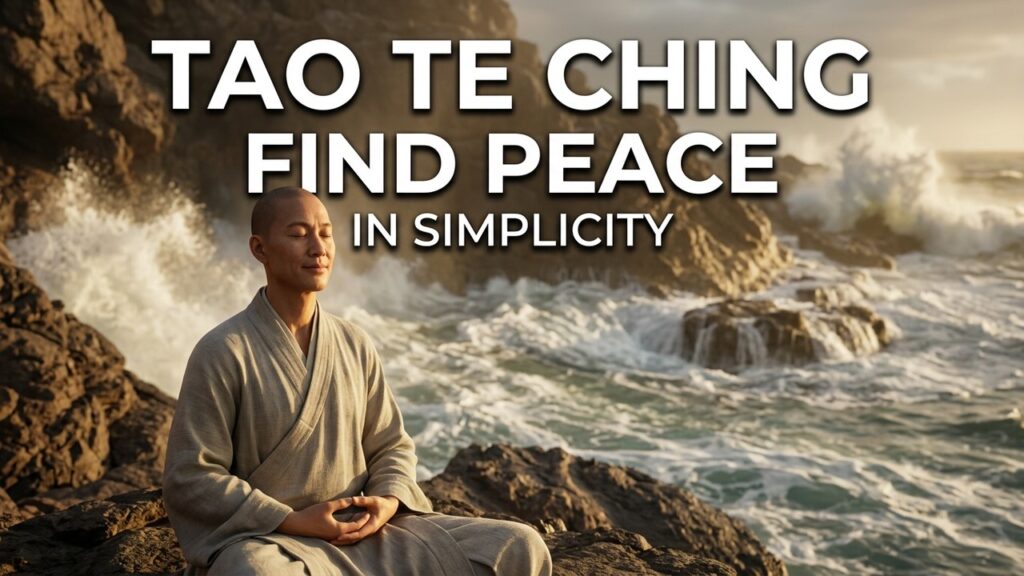
Can a text more than two thousand years old still say something useful about how to live on an ordinary Thursday? This short video is a quiet read-aloud of passages from the Tao Te Ching, the classic attributed to Lao Tzu, offered with no commentary so the words can do their own work.
Hans shares it as a ten-minute taste of the text. It is a narration rather than a conversation: a sequence of short passages in a modern English rendering, moving from the nameless source of all things, through the images of the hub, the vessel and water, to the figure of the sage who acts without forcing. Below is a guided walk through the main movements, in our own words.
This is a reading of an English rendering of the Tao Te Ching, and the summary below is our own paraphrase, not a translation. The text can be understood in many ways, and we offer it for reflection, not as proof of any claim.
The Way that cannot be mapped
The reading begins where the book begins: the path that can be described is not the eternal path, and the name that can be spoken is not the constant name. Before there are words there is an origin, and afterwards there are the countless things we name. The passage then draws a contrast between two ways of looking. Free of craving, we glimpse the mystery behind things. Full of craving, we see only the separate objects. Both come from the same dark root, which the text calls a gateway to all wonder.
Opposites that give birth to each other
Next comes the observation that calling something beautiful brings ugliness into view, and calling something good brings the not-good. Being and non-being, difficult and easy, appear together and complete one another. The sage, therefore, teaches without lecturing and acts without claiming credit. The work is done and then forgotten, and because nothing is held, nothing leaves.
Water, and living close to the ground
One of the best-loved images follows: the highest good is like water. Water nourishes everything without competing, and it gathers in low places that others avoid. The practical advice that accompanies it is almost homely: stay near the earth, keep your thinking simple, be fair in conflict, do work you enjoy, be fully present with your family. A person who is content to be simply themselves, who does not compare or compete, earns respect without asking for it.
What makes the wheel turn is the hole
The famous passage on emptiness comes next. Thirty spokes meet at a hub, yet it is the empty centre that lets the wheel move. Clay is shaped into a pot, yet the emptiness inside is what holds water. A house is built of wood, but it is the space within that makes it livable. We work with what is there, the text says, but we use what is not there. For anyone drawn to nonduality, it is a gentle pointer: what is most useful may be the open space in which everything else appears.
Returning to stillness
The narration then invites a breath: empty yourself, let the mind rest, and watch the ten thousand things rise and fall while you observe their return. To return to the root is serenity, and serenity is described as finding your destiny. Elsewhere in the reading the point is repeated from another angle: without leaving your door you can know the world, and the farther you travel, the less you may know. The sage arrives without traveling and achieves without striving.
When goodness has to be announced
There is a quiet critique of moral inflation. When the Way is lost, people talk about virtue; when virtue is lost, they talk about kindness, then justice, then ritual, which the text calls the husk of loyalty and the beginning of confusion. The sage prefers the fruit to the flower. The strongest power, it says, is the kind that does not know it is powerful, while those who keep insisting on being good often lack it.
Soft and yielding
The closing passages praise softness. A person is born supple and dies stiff, plants are tender in life and brittle in death, so what is rigid belongs to dying and what is yielding belongs to living. The hard and mighty will break, and the soft will prevail. Truthful words are not always beautiful and beautiful words are not always true. Those who argue are rarely good, the wise are not necessarily the broadly learned, and the sage, who does not hoard, finds that the more he gives, the more he has. The last line settles on a single direction: to benefit and not to harm, and to act without contending.
Try this
Pick one image from the reading, perhaps the hollow in the pot or water in the low place, and keep it with you for a day. When you catch yourself pushing, ask what would change if you simply stopped forcing. If you would like a longer narrated meditation in the same spirit, see The Way That Cannot Be Named. Watch the video above, and tell us in the comments which line stayed with you.