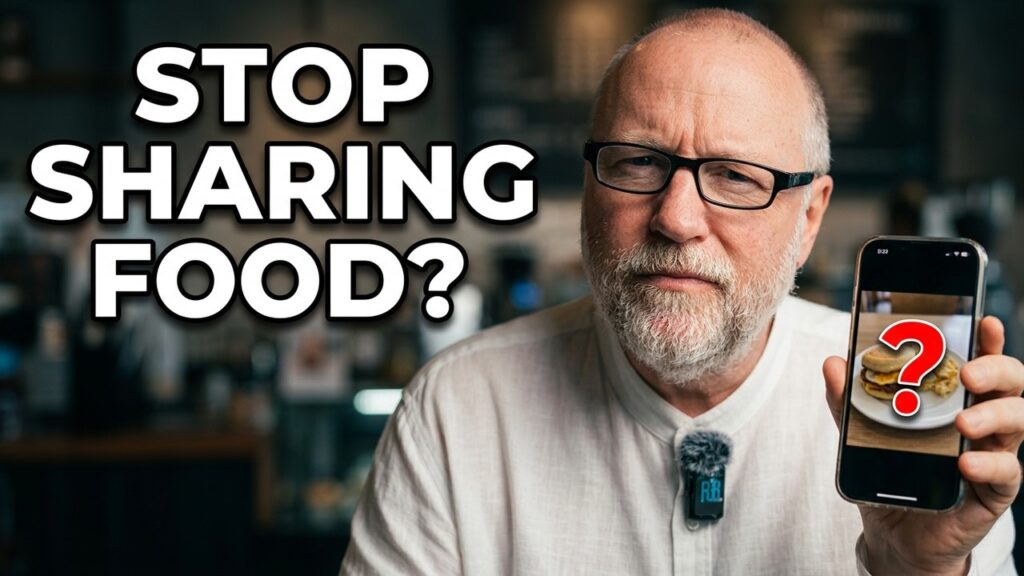
Is it really necessary to tell a computer what you had for lunch?
In this narrated essay of about seventeen minutes, Hans walks through a small story most of us will recognise: photographing a meal, retouching it, posting it and then watching the feed while the food goes cold. From there he asks what we are really after when we post, what happens to our creativity once it becomes data, and what he suggests instead.
This is a personal reflection offered as one voice among many. It is not technical, legal or professional advice, and the statements about platforms and companies are the speaker’s opinion.
The ritual of the digital meal
Hans describes the sequence: find the angle, take several pictures, retouch, perhaps ask a chatbot for a catchy face to add, trade your email for the restaurant’s Wi-Fi, post. Twenty minutes of scrolling later the food has disappeared and you hardly noticed eating it. He is careful to say that there is nothing wrong with any of this. His point is about the underlying intention: is it a genuine connection with friends, a wish for approval, a little applause, or a way to show that your life is as exciting as theirs?
The chemistry of the like
The likes you receive, he says, trigger some kind of chemical reaction that makes you feel slightly better than a microsecond before. He suggests that if we got a million likes we might not care about each one, but most of us do not, and the wish for the next small kick can grow until you need it hourly. Meanwhile you miss what is happening right here in front of you.
Communication that is truncated
He points out how limited the reply options are: a few emojis, or a written comment that is stored for an unforeseen future, cannot be corrected on the spot and is not read in your presence. Instead of a genuine conversation you get a technology-driven collection of events, and your life experience is converted into a digital format that is machine readable.
Whose idea was it, and who profits?
Hans says that a truly original idea, such as a special way to frame a picture, may go viral and then becomes part of the language the system can reuse, while the people running the machines use it to make money. He notes that some companies do share profits with creators who keep their rights, and that it is worth looking for those rather than chasing any “free” offer. He describes “free” internet as coming with a price: the information you give about your likes, language and desires feeds advertising that is tuned by software, not by someone sitting down to think of what to sell you.
Then comes the Advaita Vedanta turn. Ultimately, he says, no idea or creativity is really our own; everything is done through us, not by us, by divine grace. He adds that this does not remove responsibility, since you still have free will and “when you throw stuff at life, life will throw stuff back at you”.
Back to Earth
His closing advice is simple. Your friends are mostly occupied with their own problems rather than judging your post, so go and see them, or phone them if they are far away. Spend time in nature, accept every human who enters your life, and be present when you eat, since food nourishes the soul too if you let it.
How to read it
The description of dopamine-driven “kicks” is a popular shorthand; the talk does not cite research, so treat it as the speaker’s observation rather than a scientific finding. The claims about how platforms use data and how software selects advertising are general statements, not checked against any specific company’s practices. The statement that creativity is not “ours” is a spiritual position that not every listener will share. The practical suggestions, such as calling a friend or eating without a screen, need no belief at all.
Questions to take with you
What do you hope for when you post? What would you notice at your next meal if the phone stayed in your pocket? Related talks on this site include Is AI Dumbing Us Down? and The Ego’s Secret Addiction to Struggle. Watch the video above and share in the comments how you keep technology in its place.