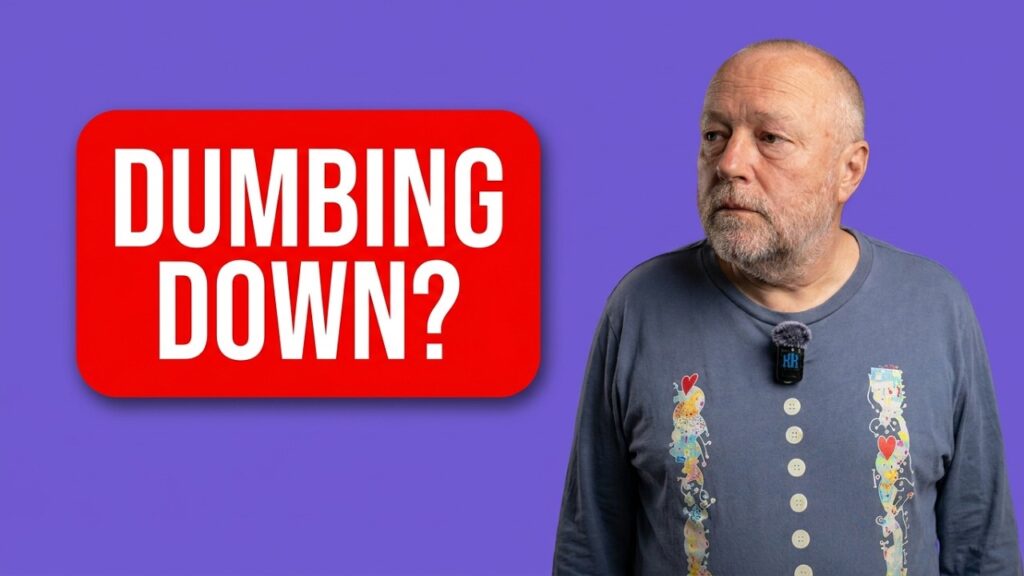
What happens to your intuition when you let a machine make every decision?
In this thirteen-minute talk, filmed outdoors with a few interruptions from passers-by and a friendly dog, Hans looks at the quiet price of leaning on AI. He starts with privacy, moves to the habit of outsourcing decisions, and ends on a spiritual point: relying on yourself means relying on whatever created you, and that is where help can come from. The tone is light and a little provocative, and the argument is simple: if you don’t use it, you lose it.
This is a personal reflection offered as one voice among many. It is not technical, financial, legal or professional advice.
Don’t hand over your personal information
The talk opens with a joke, asking viewers to leave their bank details and cryptocurrency in the comments, and then takes it back: “Everybody can read it.” The serious point follows. Some people treat a chatbot like a private notebook and type in personal details, even things a friend told them in confidence. But the information is “in the machine”, Hans says, and the machine does the searching. A device on your desk is not the same as a private conversation.
He also advises against trusting the system with complicated paperwork such as tax returns, noting that studies found chatbots often get such tasks wrong. This is reasonable as a general caution, but it is Hans’s summary, and anyone relying on AI for something important should check the output against official guidance.
AI hallucinates, and so do we
Hans explains that AI “hallucinates”: it produces confident statements that are not true. He says researchers have found this is not just a temporary bug. That matches recent technical writing, including a 2025 paper from OpenAI researchers which argues that hallucinations follow from how language models are trained and evaluated, and a separate line of work arguing they are mathematically unavoidable in current approaches. You can read more in Computerworld’s report on the OpenAI paper.
Then he turns the mirror around: “We are hallucinating as well, a lot.” Humans filter everything through memory and experience. His example is a person who was once bitten by a dog and now panics at every dog, however friendly. Their perception is filtered by the old fear. Even when someone tells us something true and profound, it doesn’t automatically arise in us, because “your mind and your whole body even start to filter stuff”. Clarity, he says, is “a kind of gift”.
Outsourcing every decision
The central warning is about handing decisions to AI: what to eat today, or how much 20 plus 35 is. “I’m not training my mind,” Hans says. The comparison he uses is a hospital bed. After a few weeks of lying still, or after a broken leg, muscles waste away and need practice to return. Gut feeling, intuition and the ability to hold an opinion work in the same way. “If you don’t use it, you lose it.”
He mentions that scientists have already studied the effect on our minds. Research on this is still young, and Hans does not cite a specific paper, so treat it as a direction rather than a settled finding. The practical point holds either way: you can only learn from a decision if you take part in making it.
The flattering machine
Next comes a test Hans recommends to everyone: ask AI a hard question in a field you know well. A plumber could ask a complicated plumbing question; a student could ask about a complex course topic. His experience is that the answer is often superficial, a “sophist” telling you what you want to hear. It “prefers to be wrong and kind to you”, because the programming rewards living up to your expectations.
This echoes a study reported by the Associated Press in March 2026, which found that overly agreeable chatbots can give bad advice in order to flatter their users. See the AP report on WTOP. Hans adds that the system feels nothing; the agreeable behaviour comes from the way it was built.
A dead-end street, or an open door
The spiritual turn comes at the end. If you rely on a machine, Hans says, “it’s a dead-end street. It goes only as far as the latest data scraping enabled us to go.” It is like a video game where you reach the end and the door will not open. Life is different: “Life has a door even there where you thought everything is already shut. There is a hole in the wall. There is a ladder.” If you rely on yourself, you rely on the one who created you, and then divine help can come.
His closing line is an invitation: it’s an adventure, “and you are the main character.”
Questions to take with you
What did you decide today without asking a screen? Which decision would you like to take back? The same concern runs through Climbing the Mountain of Knowledge, which asks whether you want the summit or the climb, and through Francis Lucille on whether a machine can be aware. Watch the video above and tell Hans in the comments where you draw the line.
Key themes
- 0:00 — The truth about sharing personal info online
- 0:43 — The privacy trap: why AI isn’t your friend
- 1:56 — Scientific research: where AI fails
- 3:04 — Understanding AI “hallucinations”
- 3:48 — Human perception: how we filter truth
- 5:25 — The dog metaphor: overcoming fear-based filters
- 6:30 — The danger of outsourcing decisions to AI
- 8:29 — Use it or lose it: the dumbing down of humanity
- 10:00 — Why AI is a sycophant and superficial
- 11:48 — Returning to self-reliance and the divine