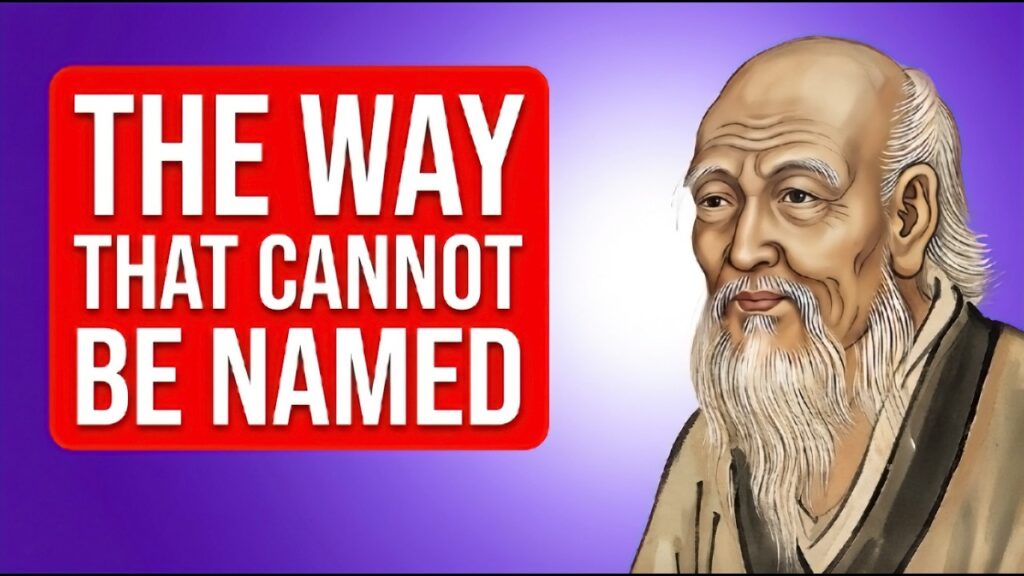
If the deepest thing cannot be named, what happens the moment we name it?
“The Way That Cannot Be Named” is a 26-minute narrated meditation in the spirit of the Tao Te Ching, the ancient Chinese text attributed to Lao Tzu. It is delivered in plain, modern language, and the video’s tags place it alongside read-aloud and contemplative content. It moves through the Tao’s best-known images (empty space, the wheel’s hub, water, the sky that plays no favourites) and keeps bringing them back to one pointer: the awareness that is looking through your eyes right now.
This is a modern retelling and meditation, not a literal translation of the Tao Te Ching. It is offered for reflection, not as proof of any claim.
Naming leaves something out
The meditation opens with its theme: “Whatever you can put into words is not the whole of it. The moment you name something, you’ve already left something out.” Before it has a name, the Way is the source of everything. Once named, it becomes this thing and that thing, “a world of separate objects”.
The first lesson is about looking. Look without wanting anything and you notice the space everything is happening in. Look because you want something and you only notice the things. “The same world, different ways of looking.”
Contrast, and letting go of sides
Nothing means anything on its own, the narration says: tall exists because short exists, and kindness means something only because unkindness is possible. Someone who understands this “stops fighting for one side and against the other”. They act without gripping the results, finish something and let it go. Strangely, the text says, this is what makes things last.
The sky is the example. Rain falls on the field you planted and on the one you did not. This is not cruelty, “it’s just no bias”, and a person who has settled into it stops needing to be anyone’s favourite.
The usefulness of what is not there
The central passage is about emptiness. A room is useful because of what is not there, a cup holds water because of its hollow, a doorway works because of the gap. Then comes the turn toward the listener: “You are more like that hollow part than you think. Whatever is aware of your thoughts right now isn’t made of thoughts. It’s the space they’re happening in.” That space, the meditation says, does not get tired or fill up.
The image of thirty spokes meeting in a hub continues the point. Your habits, opinions, job title and life story are the spokes: useful, but what you actually are is “more like the hub. The still point they’re all arranged around.”
Water, effort and rest
Several passages are practical. Everything pushed to its limit turns into its opposite, so “do the work, then step back. That’s not giving up.” The highest good is like water: it does not fight for the high ground but settles in the low place everyone else avoids, “and somehow that is exactly where its power comes from”. The advice that follows is simple: go where you are needed, not where you will be admired, say what you mean, show up on time, do not force outcomes, and “let timing do some of the work”.
The meditation also says that wanting more and faster is exhausting “in a way that having less never is”, and that loud weather does not last: “If even the sky can’t sustain a tantrum, what makes you think you can force your way through anything?”
Freedom from a fixed self
One of the most direct sections concerns fear. “If there were no fixed you to protect, there would be nothing to be afraid of losing.” Praise and criticism both make people anxious because both assume a small, fragile self that needs defending. The person who can hold body, name and reputation a little more loosely is “oddly, the safest person around”, not because nothing can touch them, but because they were never as separate as they assumed.
The text then turns the usual objection into an invitation. People call the Way invisible because they cannot see it, silent because they cannot hear it, nothing because they cannot grab it. “But notice whatever is doing the noticing right now has no shape, no sound, no edges either. And yet, here it obviously is. Aware, awake, present.” It is the same pointing found in many non-dual teachings, including Hans’s own short talk Awaken to the One.
Wave and ocean
A quiet exercise sits in the middle of the talk: let the mind go quiet and watch how every thought, feeling or plan rises out of stillness and settles back into it, “the way a wave rises out of the ocean and is still always only ocean”. Knowing this does not stop life happening. It means you are “no longer only the wave. You’re also the water it’s made of.” Later, the sandcastle makes a similar point: “I’m not saying don’t build the sandcastle. I’m saying notice you are also the tide, the sand, and the one watching, all at once.”
Leading, helping and winning
The text spends several minutes on how a wise person moves in the world. The best leader is one nobody notices. The finest help looks afterwards like it never happened (“We did that ourselves”). Real goodness does not announce itself, and when rules are needed to make people kind, “it’s already a sign that kindness left the room.” The knowing person helps without needing thanks, speaks without needing to win and gives without keeping score, and sees a difficult person as “unfinished work, which, if you’re honest, is what all of us still are”. True strength needs no proof, and someone who has really won treats it “more like a funeral”, knowing what it cost on both sides.
A small life, and the silence after
The last stretch pictures a small life well lived: good food, honest work, people nearby you love, nowhere to rush to, and peace with the neighbour’s life on the other side of the wall, because you were never as separate as it looked from inside your own head. The wisest, it says, give away what they have learned and somehow have more left. The closing words invite you not to carry any of it around like a lesson: “The words stop here. But the space they happened in doesn’t.” It ends with the sound fading, “no dividing lines, no walls to defend”, and a final Om Shanti Shanti Shanti.
Try this
Sit for a minute and notice one thought arising. Ask where it came from, and where it goes. Then notice what was aware of it. If this style of contemplation speaks to you, Notes to Self is a good companion. Watch the full meditation above, and tell us in the comments which image stayed with you.
Key themes
- 0:05 — The way that cannot be named
- 0:34 — Looking without wanting: space versus things
- 2:02 — Contrast, acting without gripping the results
- 2:41 — The sky plays no favourites
- 3:33 — The usefulness of empty space: you are the hollow
- 4:58 — Do the work, then step back
- 5:41 — Spokes and hub: what you actually are
- 7:14 — The highest good is like water
- 8:15 — Freedom from a fixed self to protect
- 9:34 — Whatever is noticing has no shape or edges
- 11:13 — Wave and ocean
- 12:04 — Leaders, help and real goodness
- 13:59 — The sandcastle and the tide
- 16:42 — Before anything existed: the mother of everything
- 19:13 — You cannot grip the universe like a project
- 23:10 — A small life well lived
- 24:39 — The words stop, the space remains