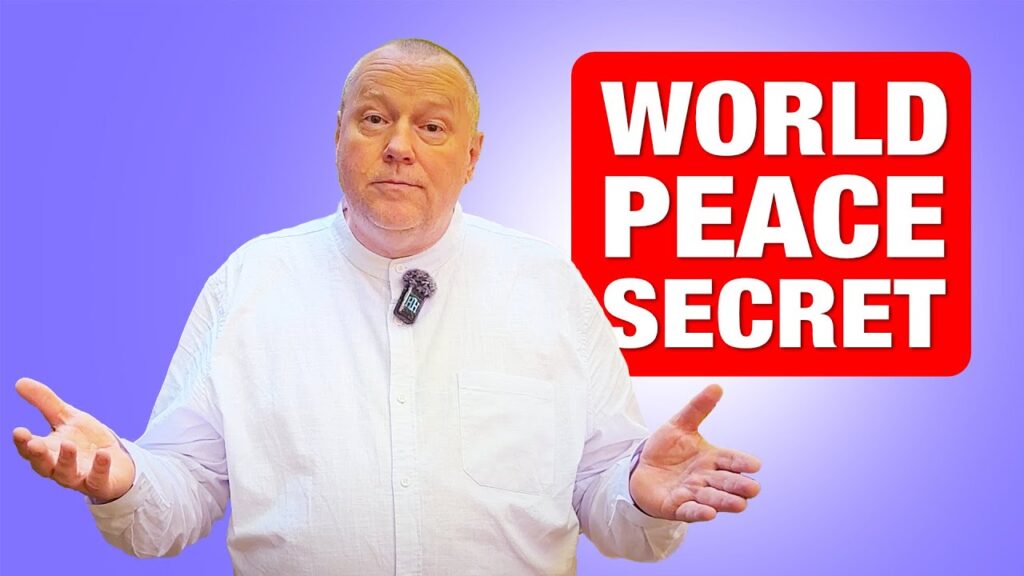
When the news fills you with outrage, are you helping to end the conflict, or feeding it?
In this monologue of about eight minutes, Hans speaks directly to the viewer about war and peace. His argument is that the outer world is an expression of our inner world, and that our attention to drama and injustice may give it more power. It ends, as many of his talks do, with “Om Shanti Shanti Shanti.”
This is a personal reflection offered as one voice among many. It is a spiritual viewpoint, not a political analysis, and it is not advice of any kind. It does not ask anyone to ignore the suffering of people affected by war.
A truth you might reject
Hans begins by saying he could tell us right away how to provoke peace on the planet, but that we might reject it without two ideas. The first is that although we seem to be separate individuals, he says we are not: we are part of “the divine, the One” that is the source of everything. If this is unfamiliar, he suggests investigating the spiritual concept of the One. From this view, everything external is at the same time an expression of ourselves.
The outer world as expression
The second idea is that the outer world seems to have power over our feelings, but in his words this is a misunderstanding: the outer world is “an expression, a creation of our inner world”. Beyond our judgment, he says, there is a truth with a capital T, but with our limited perception we cannot see it, and that ignorance makes us judge what we take to be reality.
The choice to observe
Just as a baby learns to walk, Hans says, we can learn to observe how the mind judges the outside world. Instead of believing everything we think, we can step back from the immediate reaction. He compares this to growing up: as children we might throw ourselves on the floor demanding things, and as adults we learn that we have options in how we react. He adds that our reactions affect events and lessen their power over our feelings.
Inner peace and outer peace
“World peace is a mirror of our ability to contemplate inner peace,” he says. He describes an “invisible connection” between staying in inner peace and conflicts in the world, and says that every time we are swept up in drama and what he calls a morbid attention to injustice and war, we are “empowering the unwanted”. He urges making peace with ourselves and with anyone around us unconditionally, rather than setting conditions for peace that, if unmet, let us avoid it.
What he is not asking
Hans is clear about limits. He does not ask us to allow war to happen, he says, which would just be another condition. He asks us to allow what is and to love ourselves, and others even when they do not meet the conditions to be loved. He is not asking us to hug an enemy or to permit others to do harm. “Just do your best. Practice unconditional love.” His closing line is “Stop feeding war to create peace,” and he reminds us that we are loved, perfect and worthy.
How to read it
This article is based on auto-generated English captions, so wording may differ slightly. The idea that our inner state creates or manifests outer events is a spiritual conviction, not something that can be shown, and many people, including other guests on this channel, would put more weight on action, justice and politics. It may be most useful as a question about what we choose to give our attention to, and not as a claim that anyone’s suffering is caused by their thoughts.
Questions to take with you
When you read hard news, what do you do with the feeling that follows? Where in your own life is there a conflict you are waiting for others to end first? Related talks on this site include Fighting for Freedom, Really? A Reminder That War Is Not a Game. Watch the video above and tell us in the comments what you took from it.