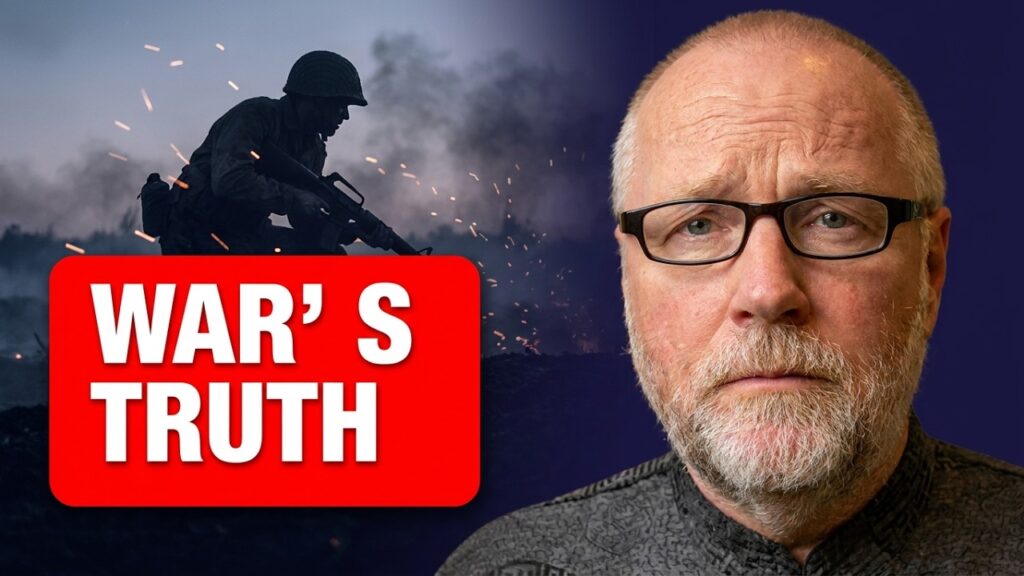
What happens when a game or a fantasy about fighting becomes real?
In this twelve-minute talk, Hans starts small, with the creatures we meet everywhere and the question of whether kindness costs us anything, and then moves to the weight of choosing to become a soldier. He asks the viewer to evaluate their options before a decision leaves its mark, and closes with a nonduality argument about separation.
This is a personal reflection offered as one voice among many. It is not political, medical or professional advice, and it does not tell anyone what to do about military service. The claims about science and the mind are the speaker’s own views.
From tiny creatures to a first choice
Hans begins with a simple observation: wherever you go there are living beings around you, and even your way of moving is a form of communication. He suggests greeting small animals with a friendly “hello, how are you?” rather than using superior force just because you can. Some children kill a small animal for fun, he says, and doing something simply because you are able to do it is not always the best choice.
Choices that mark a life
Some choices, he says, taint your life with a negative or, in the best case, a positive atmosphere. He turns to soldiers, many of whom suffer from post-traumatic stress disorder, and lists reasons people join up: economic interest, the idea of being powerful and seeing the world, or the company of like-minded friends. Hans mentions that he was born at the Danish border to Germany, and tells the story of August 1, 1914, when the Danish politician H. P. Hansen recorded in his diary that Danes mourned in the street while pro-German groups celebrated the mobilisation with flags and cheers. In the speaker’s telling, that borderland enthusiasm faded as the brutal reality of the war set in.
Virtual and real
Killing in a video game or in a daydream is easy because it is not a true event, he says. The moment it becomes real, “your life has changed forever”. He notes that studies exist on the aftermath, and that although some people are numb to the experience, most are not. He adds that no parent would wish this on a child, and that being a soldier, or about to become one, does not take away your ability to be a human or to choose. If you choose love, he says, divine grace might protect you; if you choose hate and violence, you will suffer the consequences.
Limiting beliefs and the mirage
The second half moves to belonging. Social pressure about politics, country or ethnicity rests on fantasies and limiting beliefs, Hans argues, built on the illusion of separate entities: me, you, they. Physically, he says, there is no separation between us, since everything is filled with matter, and yet what matter actually is remains an open problem. He also says that so far no scientist has seen proof that the mind sits in the brain. The mind reflects everything that appears, and like the mirage of a fountain in the desert, a perception can seem real until we try to reach the water.
Taking the judgment away
His practical tool is to ask “is that really so?” when troubled by events, and to take away the judgment so that the event stands naked, without added flavours, causes or effects. From there you are free to look at what is. He closes with an invitation to let go of yesterday, avoid clinging to a promised tomorrow, make one step at a time and “enjoy the ride”.
How to read it
The talk is a reflection, not an analysis of war or military service, and it cites no sources for its figures about soldiers. Post-traumatic stress is well documented in veterans, but how common it is varies widely between conflicts and studies, and many people who serve do not develop it. The diary episode from 1914 is told from memory by the speaker and has not been checked here. His statement that no scientist has proof that the mind is in the brain is contested: most neuroscientists hold that mental activity depends on the brain, while what consciousness itself is remains unresolved. The idea of oneness is a spiritual position that cannot be tested, and the suggestion that love may bring protection is a matter of belief.
Questions to take with you
Which choices in your life would you hesitate to make if they were real rather than imagined? What judgments could you take away from one event today? Related talks on this site include Bad People and Why You Should Love Your Neighbour and Does Morality Matter? A Spiritual View. Watch the video above and share your reflections in the comments.