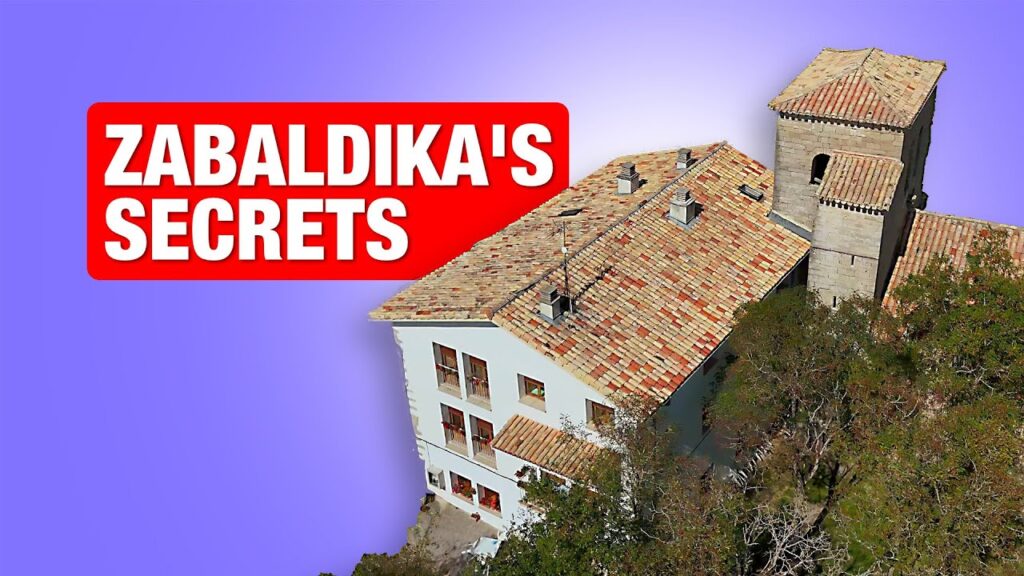
Why would a group of sisters open a church in a valley where nobody expected pilgrims?
In this short video of about ten minutes, a Spanish sister of the Sacred Heart of Jesus welcomes visitors to the church of San Esteban in Zabaldika, on the Camino between Roncesvalles and Pamplona. She explains who runs the donation albergue, why the sisters came, and shares a few details about the church that are not in the leaflet.
This is a personal account from one sister, offered as one voice among many. She speaks only for herself, and nothing here is an endorsement of any belief as fact.
A welcome, and who is serving you
The sister begins by welcoming pilgrims to Zabaldika. She explains that the couple serving dinner are not employees but volunteers, pilgrims who, in thanksgiving for what they received on the way, give back as hosts. They work in a donation-based albergue, with no fixed price and no reservations, and try to create a spirit of community at the shared dinner. Volunteers stay for fifteen days, sometimes as a couple, sometimes as strangers learning to cooperate, and she says that this too is an exercise for them.
Why the sisters came
The sisters, she says, did not come to run an albergue. They came to open a beautiful church for pilgrims, because the valley had been uninterested in pilgrims and there was nothing between Roncesvalles and Pamplona. Other little churches on the way, she adds, are not as beautiful, and this was the right place. The sisters belong to a congregation present in 42 countries, of French origin but international.
One congregation, many countries
She describes how the congregation is gradually becoming more united across regions, for example North America with Mexico, and in Europe the French sisters with Belgium, Holland and Italy. The Spanish sisters, she says, never imagined it, but are now joining with Poland, and the project in Zabaldika is possible because of Polish sisters. Only retired sisters can live there, she explains, since those still working would have to commute to Pamplona. Younger Polish sisters often speak good Spanish, while her own generation speaks French, so groups mix languages, and Polish, she jokes, is the third most difficult language in the world, so the older sisters are not expected to learn it. She also mentions that a Polish sister had recently left for family reasons and that another was expected from Slovenia.
Details of the church
She points out several things a visitor might miss. The little Jesus figure is a donation and dates from the sixteenth century. A photo exhibition meant to stay one month has been there, she estimates, for at least thirteen years, showing images of the northern way. Visitors may go up to the bell one or two at a time and ring it gently, not to play but to listen to its long vibration. There are no candles for safety reasons, only small lamps, and visitors can write a note to Christ.
A Polish saint in the altarpiece
The sister says that no one knows why Saint Stanislaus of Krakow appears in this altarpiece, which otherwise shows saints from the whole church, and that his statue is different from the others. She guesses that a rich Polish pilgrim may have wanted him there when it was built. For Poles, she says, he is a hero who told the truth to a king who did not care for his people and was killed while celebrating Mass. She compares him to Oscar Romero, who was killed in Latin America in the last century after speaking the truth to the army and politicians. She presents this as her own explanation and as a guess.
How to read it
This article is based on auto-generated English captions of a speaker using her second language, so some phrases and details may differ from what was said. The history of the figures and the guess about the altarpiece are her account, and we have not checked them against other sources. Other guests on this channel approach pilgrimage from different faiths or from none.
Questions to take with you
What would you open for strangers if you knew nobody expected it? What is the difference between a hostel and a place where the people serving you do so as thanks? Related talks on this site include My Life Was Over, Then I Walked the Camino. Watch the video above and tell us in the comments what you took from it.