You were born as yourself, so what exactly are you supposed to become?
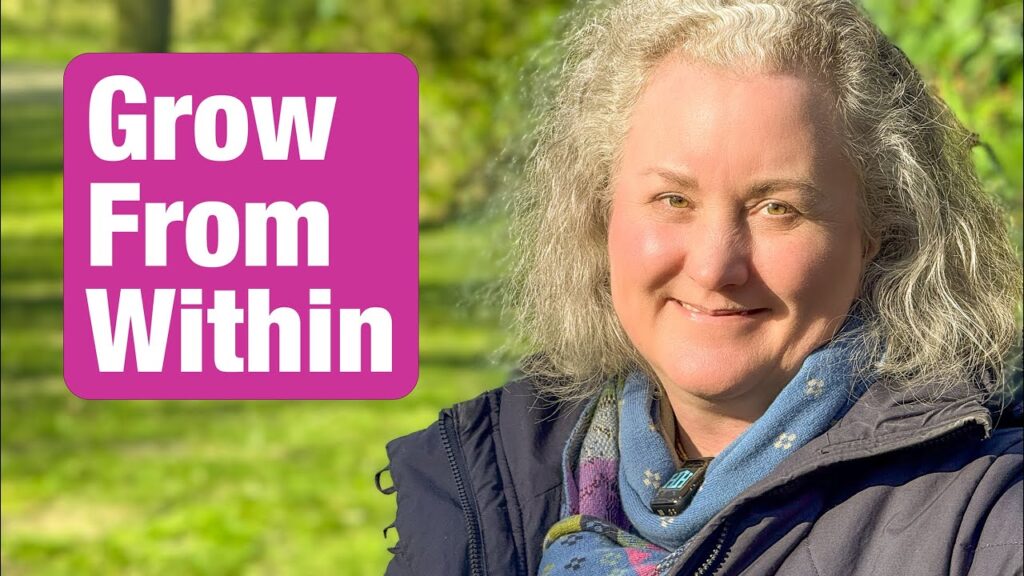
In this conversation recorded outdoors in spring, a woman who introduces herself only as “me”, not as a representative of any institution, talks with Hans about self-discovery, why she distrusts the word “spirituality”, and a lifelong relationship with the divine that grew from a childhood prayer.
What follows is the speaker’s personal perspective as shared in the conversation. It is not medical or psychological advice, and we share it as one voice among many.
From digging for dinosaurs to digging for meaning
She describes herself as a child who was never satisfied with the surface. In the garden she dug holes hoping for dinosaur bones and dreamed of becoming an archaeologist. Later the digging moved into thought: her life, she felt, had to have meaning. Alongside that, though she grew up in a completely non-religious family, she had an inner certainty of a loving presence looking out for her, and she began to pray by herself.
Learning Sanskrit to think for herself
She studied philosophy and Indology so she could read Sanskrit and not depend on others to interpret the wisdom of the world for her. She values teachers, comparing it to learning an instrument from a master, but wanted to be a mature student who does not hand over heart and brain. In India’s philosophies she found one school, between “everything is one” and “everything is separate”, that appealed to her because life, she says, is oscillating, dynamic, and happens in between.
Why “spirituality” can be a harmful idea
Asked about the word itself, she is blunt: she finds it harmful when it suggests you must choose between spirit and matter. In her view suffering comes from splitting up things that belong together. A “spiritual life” set apart from a “material life” can produce a divided personality, she says, with natural human urges suppressed and then breaking out later.
Becoming who you are, like a tree
When Hans asks whether we are not already ourselves, she uses the image of a tree: the whole tree is in the seed, but it still takes time and weather. Her point is trust. What you are is what you are meant to be, so accept it first. Going against the flow of growing, ageing and dying, she says, makes it more painful.
Reconnecting the layers
She names two kinds of disconnection that cause pain. One is within the person: doing what you do not feel, or thinking what you neither feel nor say. The other is between the body-mind and the spiritual self, whether that is feeling cut off from it, or the spiritual self mistaking itself for the body and mind. Her suggestion is to be like a loving parent to all of it, including the spark of consciousness, and to grow from inside out rather than from outside in, while respecting people who find the reverse works for them.
Desire and fear
On desire and fear she says both become illusions when we try to hold on to things or fear that something will damage us permanently, since everything changes. Desire is different when it is a wish to live authentically, with the flow of life.
Devotion and knowledge, not either-or
She once thought knowledge and devotion were opposites, but now sees relationship as the beginning. To love someone you want to know them, and in the bhakti tradition that can turn into long lists of practices. Her own realisation was that the best gift she can offer God is herself, with her attention and her readiness to receive and pass on. She also stresses that the person remains: relationship is between persons, and a “static” consciousness is only one side of it.
Receiving love
Unconditional love, she says, is something we can receive and let pass through us, but not manufacture. Trying to love like God, she jokes, would blow up the ego like a balloon. Be ready to receive instead.
Life, death and eternal relationships
On reincarnation she declines to speculate. She does not remember former lives and says nobody she knows has come back to report, so she sticks to what she knows: life carried her into this life and will carry her through death, and relationships with her “spiritual family” are, she is certain, beyond time and space. When Hans mentions people who were declared clinically dead and came back, she answers politely that it is their story, not hers.
A teacher she never met
She tells the story of a German scholar of religion and Indology of the 1920s and 30s who became a disciple in the Gaudiya Vaishnava bhakti tradition, lived in India for around three decades, and translated its texts into German. Reading a book of his translations at 19 struck her “like lightning”, and she says her first reaction was anger, because everything she had planned dissolved. She tried other paths, including Christianity, before accepting that she belonged there. Now, over fifty, she describes herself as having been ground like corn and become softer and more accepting.
Walking a parent toward death
She speaks gently about her mother’s long, serious illness, and about learning to be present rather than to do too much. The image that helped her was the lamps floated on a river at Diwali: trusting that the river carries the light where it is meant to go. She accepts the experience as a gift and hopes she has become a better companion.
Loving yourself, being loved already
Her closing thought is to live with yourself lovingly, not merely to tolerate yourself, and to know that you are already loved without contortions. Service then happens naturally, without checking boxes.
Chapters
- 0:10 — Being authentically yourself, not a representative
- 0:53 — Childhood curiosity and the wish to find deeper meaning
- 2:00 — The intellectual journey and the search for purpose
- 2:21 — An innate sense of connection and personal prayer
- 3:11 — Inner certainty and intellectual exploration
- 4:49 — Philosophical schools in India
- 6:04 — The potentially harmful concept of “spirituality”
- 7:41 — “Becoming who you are” versus already being yourself
- 8:29 — Trusting life’s flow and accepting yourself
- 10:46 — Interconnection within and with the spiritual self
- 13:54 — Inner transformation versus outward practices
- 14:34 — Desire and fear