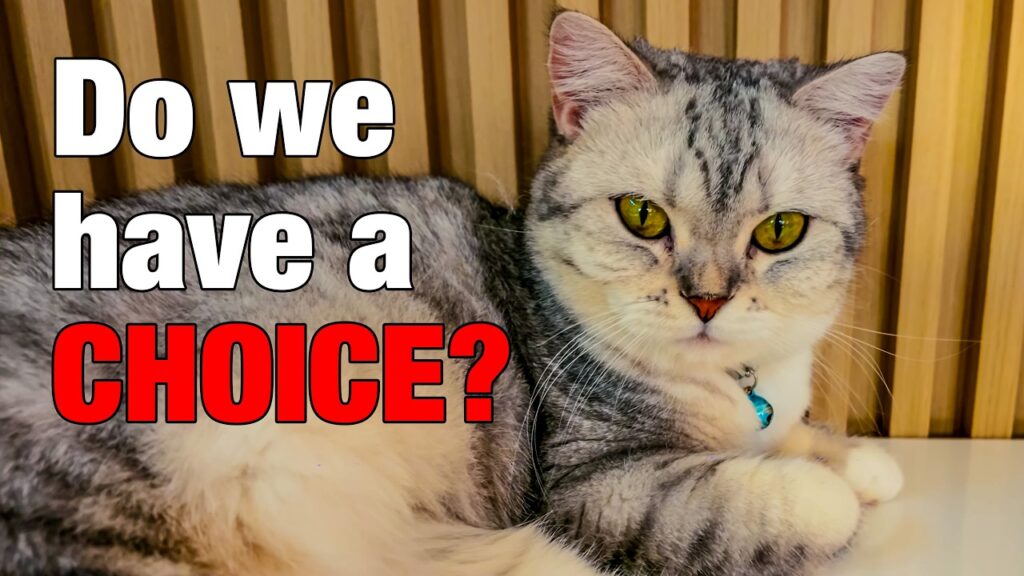
Did you choose to read this, or were you nudged?
In this narrated essay of about nineteen minutes, Hans invites the listener to look at their own decisions. It starts with a small experiment, a request to take three deep breaths, and uses it to ask who is deciding, what we are not, and how attention shapes the life we experience.
This is a personal reflection offered as one voice among many. It is not psychological, medical or professional advice, and its view of a spiritual self is a conviction, not an established fact.
The experiment
Hans begins by saying you chose to listen, and asks you to stop, close your eyes and breathe three times. Then he asks: did you do it because he suggested it, or because you decided? The point, he says, is less what you did than who did the deciding. He separates acting from reacting: you may have chosen actively, or you may have gone along to meet someone’s expectations, or drifted with the flow to avoid deciding at all.
Nobody can make you without permission
Hans argues that no one can make you do something unless you give them permission over your doing, and that even believing others hold power over you is a choice you made or have already made. He anticipates the objection of violence and points instead to historical figures who endured great suffering to follow what they believed, and in doing so showed others another way. They did not force anyone, he says; each person chooses whether to take on a new approach.
What influences the chooser
He then asks what led you here: a book, a comment, a film, a dream, an advertisement on a wall. Endless triggers are offered every moment, and any of them can influence the next step. If external events or inner feelings guide our actions, he asks, who decided to have those reactions, and where do inspired thoughts come from?
What you are not
To approach who you are, Hans says, look at what you are not. You are not your body, which changes from birth to death, and you are not your mind, since you can fall into deep sleep and return, and thoughts shift with age, tiredness or excitement. In his view you are a spiritual being in a human form, with a mind that thinks. He asks: did you choose to be a spiritual being, and who chooses to be or not to be?
Stories and attention
Much suffering, he says, comes from beliefs and stories about ourselves, such as a name, an address and a history of potential, which were made up by others or by us. We can choose a different story, and he suggests testing it by how it feels: what feels good may align with your purpose, and what feels bad can be tweaked. Anything you focus on grows like a plant. Giving attention to what you dislike waters the weeds; appreciating what feels good, even a tree outside the window, waters the plants of bliss. In the end, he says, it is consciousness that experiences the world through your senses, and he closes with “it is your life, it is your choice.”
How to read it
This article is based on auto-generated English captions, so some details may differ from what was said. The essay speaks from a nonduality-inspired perspective and presents free will as a given, while many philosophers, scientists and other guests on this channel see free will very differently. The advice about attention and gratitude is a reflection, not a treatment for anyone dealing with depression or hardship, for which support from others is wise.
Questions to take with you
What is one decision you made recently that you could trace back to a trigger you had not noticed? Which story about yourself would you rewrite first? A related talk on this site is The Key to Happiness: Choose Your Story, Question Who You Are. Watch the video above and tell us in the comments what you took from it.