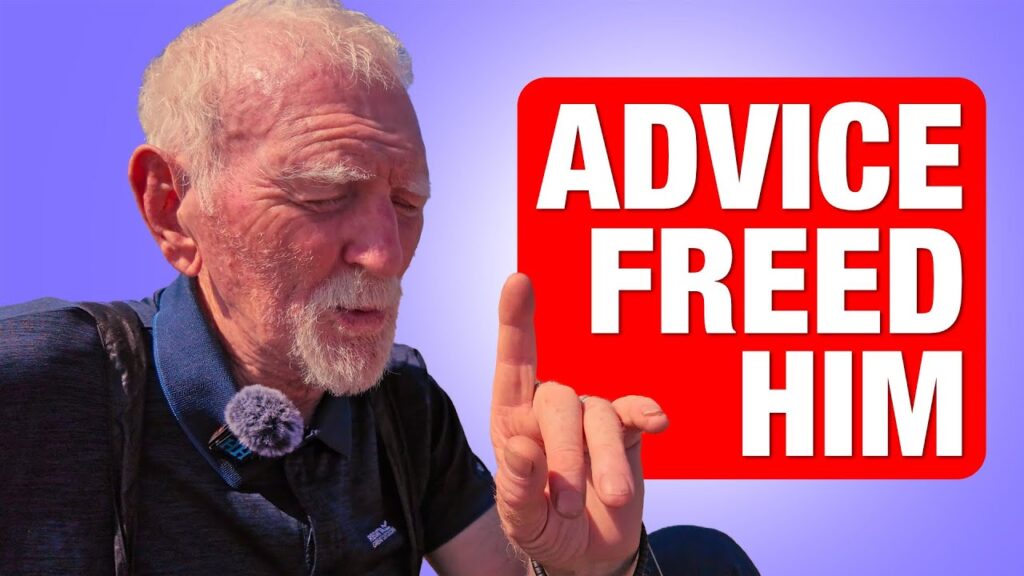
What would you say to a stranger who tells you he has lost all hope?
In this video of about seventeen minutes, Hans speaks with Dominique, a pastor of 35 years who lives in County Kerry in Ireland and is walking his eleventh Camino de Santiago. He shares experiences from his childhood, a story from the trail, and strongly held views about prayer, reading the Bible and the church.
This is a personal Christian testimony, offered as one voice among many. Dominique speaks only for himself, and nothing here is an endorsement of any belief as fact or a substitute for medical, legal or mental health care. If you are in despair, please reach out to someone you trust or a local support service.
Experiences from childhood
Dominique, whose family calls him “Huggy” because he loves to hug, says that as a child of 10 to 12 he followed his grandmother to early morning Mass. He describes seeing a white board or bird on the tabernacle, which he says landed on his shoulder and flew through a window, and a feeling of being lifted and all his troubles gone. At 19, he says, a priest told him the window was 400 years old and had never been broken. Dominique says life then became strange and he felt people thought him a weird child, until, as he tells it, he was called back, this time by an angel. These are his own accounts of experiences, which we cannot verify.
Listening to the small voice
He says to listen to the Holy Spirit’s “small still voice”. His rule of thumb is that God is cryptic and the devil is simplistic: when God speaks your first answer is “I couldn’t do that”, and the easier option feels like the wrong voice agreeing with you. He adds that God does not mind when you take the wrong turn, and will bring you back around.
A conversation on the trail
The story he calls most poignant is of a man he met on the Camino, who after some talk told him he had come to end his life, and that he was facing a charge relating to an attempt on his best friend after finding him with his wife. Dominique says he was shocked, then told the man to call his solicitor, and suggested what to say about the circumstances. He says they parted, and four weeks later, in Santiago, the man put a hand on his shoulder and said he would never forget what they spoke about. Dominique takes this as grace. We have kept details light and share this as his account only; it is not an endorsement of any legal approach.
Trust, scripture and prayer
He argues that the church emphasises faith, but that God first asked for trust. He urges people to find a place where they feel God in their spirit. His best advice, he says, is “do not read your Bible every day” in the sense of rushing through it in a year: take one verse that jumps out at you, write it down, read it for six days and wait. On prayer, he reads the Our Father as a pattern, says to thank God immediately when asking, and now prays “thank you for what you’re going to do next”. He tells of an aunt who prayed for twenty years and advises trust over repeated asking. He also says God may take us through hardship so that we can later give a testimony.
How to read it
This article is based on auto-generated English captions, so some details may differ from what was said. Dominique’s views on the church, prayer, the devil and scripture are strong personal convictions, and other guests, including other Christians, see these things differently. His suggestions are not medical, legal or psychological advice. His closing image of writing a word on the soles of your shoes is symbolic and a matter of his own tradition.
Questions to take with you
When did a stranger’s honesty last change how you saw a situation? What would it mean to trust before you see the answer? Related talks on this site include My Life Was Over, Then I Walked the Camino. Watch the video above and tell us in the comments what you took from it.