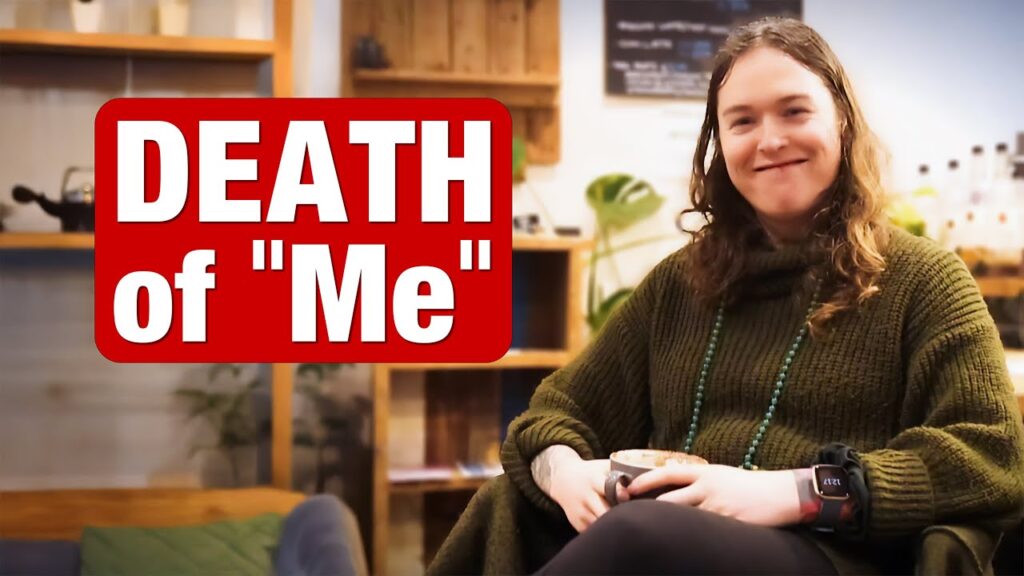
“I seem to be a communicator. I’m not a teacher.”
That is how Alexis introduces this conversation with Hans, and it sets the tone for everything that follows. What is exposed, Alexis says, is not coming from a person at all: “All there is is nothing being everything.” No instructions, no practices, no path. Just a very direct pointing at what is already here, and the collapse of the one who was looking for it.
What follows is Alexis’s own account, offered as a personal expression and pointer, not as a teaching or as proof of anything.
“All there is is nothing apparently happening”
Alexis places this in the territory of what is called non-duality, the same neighbourhood as teachers such as Tony Parsons and Jim Newman. The word simply means “not two.” There is no separation, no subject and object, no real distance. “It’s an alreadyiness. The exposure of what is already.”
That means no separate self sitting inside the body and steering it, no real “now” and “then,” no real “here” and “there.” There is only immediacy, and immediacy is total: “It’s boundless. And therefore it’s without direction. It’s this, which is all there is. And this which is all there is is nothing. It’s not a thing. It’s not objectifiable.”
What happened: the sense of “me” collapsed
Asked what happened, Alexis answers plainly: “I died.” Not dramatically, Alexis adds, but the whole sense of there being a “you” or a “me” collapsed and was revealed as illusory, something that never was a reality in the first place. So no one really dies. What is left is only what is happening, with no sense that it is happening to anyone, for anyone, or by anyone.
Before that, in the story, there were moments of feeling like someone listening and talking, controlling the body, living a personal life. And other moments, less and less of them, where that sense was missing altogether.
The seeker who went from teacher to teacher
Alexis describes the seeking that came before: spirituality, religion, even materialism, always looking for something more wholesome. Teacher after teacher, practice after practice, tradition after tradition. None of it satisfied, because there was still a “not okayness” with what was appearing.
Then came someone who wasn’t telling Alexis what to do, wasn’t even speaking to a “me” who could do or achieve anything. What was revealed was obvious and yet could not be known:
What you, so-called you, have been longing for this whole time is already. It can’t be limited by being in the future. It can’t be limited by being in a state. It can’t be limited to an experience. So it could never be achieved.
Alexis suggests this is what every tradition and religion is trying to point to, but through dualistic means. That is their predicament: they are talking to someone who isn’t actually there.
A passionate aliveness for no reason
What is it like afterwards? “A passionate aliveness that comes out of nowhere and nothing.” The trees, the plants, wildlife, the cosmos: everything is freely, vibrantly expressing for no reason. “It’s glorious.”
Hans asks whether this is infectious, whether it is “exposing” other people. Alexis points out that this question assumes cause and effect, and cause and effect belongs to the reality of separation. If there are no separate things, there is nothing to cause or affect anything. So the collapse isn’t caused by anything either. It is more like a train pushing through a brick wall and discovering there is no other side to it.
Why it can feel disappointing
Alexis is candid that this can be very disappointing to anyone hoping for something to hold on to. We keep wanting something to relate to, whether a person, a place, an imagined future, a teaching, a practice, an initiation or an altered state. It is a search for validation and something to own.
But there is no game to play here: “There’s no saying, ‘I’ve got something that you don’t.’ There’s no saying, ‘I’ve lost something that you have.’ There’s just an exposure of immediacy, which is all there is.”
What is spirituality, then?
For many, Alexis suggests, spirituality appeals to those who are sick of materialism and haven’t found what they were looking for in television, sex, drugs or rock and roll. So they look for wholeness in tantra, meditation, yoga, breathwork, qigong, religion and books.
The problem is that they look for it in things. Even spirituality becomes one more thing a person relates to. “Wholeness can’t be found through any practice, because wholeness is not separate.” There can be no finding of wholeness when it is already everything.
“Where is my exercise?” Free will and the doer
Hans pushes: surely there should be something to do. Alexis answers that the dream of “me” always wants something to do, and if it is told what to do, it is validated as an entity that can do something. The idea of free will and choice is a misinterpretation. It feels, energetically, as if someone in the body is driving, but that “someone” is just energy appearing in that form.
And there is no instruction that could move anyone toward what is unconditional: “It’s the suffering as well. It’s the pain. It’s the joy. It’s absolute. It’s everything.”
Hans admits that he is driven to run this YouTube channel and talk to people, and wonders whether he should just leave the world alone. Alexis’s reply is disarmingly simple. It isn’t useful, but there is also no one doing it. “If it’s joyful, it’s joyful. Then why not?” There is no I in control and no I that is not in control. Both are equally absent.
Teachers as puppets, and the world as a stage
When Hans asks what it is like to meet spiritual leaders, Alexis says there is “the appearance of authority,” but no sense that anyone is actually happening. Teachers are like characters on a stage, “a play really,” with no audience. This isn’t meant as a put-down; it is just how the play looks from here.
What about the suffering in the world, the news, the wars? Alexis says that what appears in the news can look like “a collective and individualistic expression of need not being met,” a hole that can never be filled. This exposure offers no practical advice for solving the planet’s problems, because it isn’t addressing anyone who could solve them.
Four pillars that collapse
Devotion, knowledge, discipline: all the usual methods are part of a relative dream. Alexis names four pillars of the sense of separation: ownership, relationship, knowledge and doership. When separation goes, all four fall with it. There is no separate self to know what is going on, to own anything, to relate to anything, or to do anything.
Is that harsh? Alexis insists it is the opposite:
This is the compassionate exposure that you’re already not separate. There is already no you. There is only unconditional love. But it’s not love on anyone’s terms and conditions.
No soul, no other shore
Hans asks about the soul. Alexis’s answer: there is no soul without continuity and no soul without separateness. The idea of a soul is “a very sweet idea” that keeps a sense of separateness feeling secure, giving it hope of surviving the death of the body.
And what happens when we die? “You already died, and it’s wonderful you’re talking to me from the other side. There’s no other side.” There are no fences or shores, no far bank where the awakened ones wait. No one lives or dies. What feels so real is the unreal, and it is made of nothing and of no one. “So there’s nothing to be afraid of,” Alexis adds, though not on behalf of anyone.
Meeting Tony Parsons and Jim Newman
Hans asks whether Alexis ever met others who had “died” in the same way. Alexis says there were conversations with Tony Parsons and Jim Newman, and describes them as “so impersonal” and yet so loving that it could not be comprehended: a love that “didn’t care for the personal wants and needs of a separate dream that was never happening.”
Rejection and ridicule, resonance and elation: all equally free. Everything is equal, and yet there is no separateness to be equal.
Home is already here
Alexis closes the main thread with an image of home. Home is unconditional, so unconditional that it can appear as a child running away from home. But there is never a running away, and therefore never a coming back. “There was never an away from home. And there is never anyone to be home even.” What seemed missing, lost or hidden was always already what was longed for.
Kali, the divine feminine, and the dream of individuality
Alexis shares that, just for fun, the body resonates with archetypal stories of the divine mother and the divine feminine, as well as the divine masculine, much as you might enjoy a film. Kali, Alexis says, is another depiction of that which brutally and without compromise annihilates the dream of separation. In Hindu iconography she is traditionally shown wearing a garland of skulls or severed heads, an image of the end of the ego rather than of literal violence.
The dream of individuality sees this as terror and wrath, something to run from, and goes off seeking its own immortalised, imagined state. But when it comes home, it meets her grace and her death at once. “The whole awakening is the complete death of the dream of individuality, separation and distance, which is unconditional love.”
Hans wonders if he can brag about all this to his friends. Alexis laughs: “It defies ownership.” Alexis mentions holding weekly meetings, events and one-to-one conversations, and shares a website at the end of the video for anyone who is interested.
Chapters
- 0:00 — A communicator, not a teacher
- 1:00 — No two: the “alreadyness” of what is
- 2:01 — What happened: the sense of “me” collapsed
- 3:01 — Seeking from teacher to teacher
- 5:03 — Why every tradition points dualistically
- 6:00 — Passionate aliveness and the end of cause and effect
- 9:02 — Why this can feel disappointing
- 10:01 — What is spirituality?
- 12:01 — “Where is my exercise?” Free will and the doer
- 14:01 — Running a YouTube channel with no doer
- 17:02 — Teachers as puppets on a stage
- 20:01 — The news as unmet need
- 21:02 — Ownership, relationship, knowledge, doership
- 23:01 — Compassion and the idea of the soul
- 25:00 — What happens when we die?
- 27:03 — Conversations with Tony Parsons and Jim Newman
- 29:02 — Home is unconditional
- 32:02 — Kali and the death of the dream of separation
- 33:02 — Closing words
Full transcript
Auto-generated from the video’s captions and lightly corrected. Names and terms may still contain errors.
Alexis: Yeah. So my name’s Alexis and I seem to be a communicator. That’s what seems to be happening. I’m not a teacher. I’m not classed as a teacher or someone who’s instructing or giving people teachings or practices, advice, instructions, guidelines at all. What seems to be exposed, although the suggestion is it’s not actually coming from me, there is no me, the suggestion that seems to come out of this exposure is that all there is is nothing being everything. All there is is nothing apparently happening.
Now those words may seem to sound very similar to other voices like Tony Parsons and Jim Newman. This is what’s considered non-duality. It gets called non-duality. Non-duality is, well, it’s not two. That’s simply what it means. And the exposure is that there is no two. There is no separation. There is no subject and object already. There’s no real distance or separation already. It’s an alreadyness. The exposure of what is already. So there’s already no separate self to be separate. There’s no self that’s in the body that is actually driving the body and making it go in a certain direction. There is no real now and then either. There’s no real here and there either. There’s no separation really on any level. There just is immediacy. And immediacy is total. It’s all there is. It’s all-encompassing. It’s totally free. It’s boundless. And therefore it’s without direction. It’s this, which is all there is. And this which is all there is, is nothing. It’s not a thing. It’s not objectifiable. It’s not subjectifiable. It’s just nothing. All there is is nothing apparently happening.
Hans: What happened to you?
Alexis: Quite simply, I died. Without meaning to sound overly dramatic, the whole sense of there being a you or a me just completely collapsed. It was revealed for its illusory nature, that in the first place it never actually was a reality to collapse. So no one really dies, but the whole sense of there being a person in a body was exposed as artificial. And then what’s left, only apparently, is what’s happening, but there’s just no sense that it’s happening to anyone, for anyone, with anyone or by anyone. We can tell stories which might make Alexis sound special, but there’s no sense of specialness really without that experience. For the sake of stories, and for the fun of it, without meaning to indulge in it: in a timeline there were moments where it felt like there was a sense of someone here listening and talking, autonomously controlling the body and going around having a lifetime, a personal life and experience. And then there were other moments in the day where there was less of a sense of that, or no sense of that at all.
In that story line, which is fictional, not factual, there was seeking, seeking for something greater, for something more, for something wholesome. Seeking is a very personal experience. It’s seeking in spirituality, it’s seeking in religion, it’s seeking in materialism. It’s seeking all the time for something else. It went from teacher to teacher, tried different practices, got into different traditions, and eventually it wasn’t satisfied with any of that, because there was still this not-okayness with what’s appearing to happen. And then it finally discovered someone who wasn’t telling me what to do at all, wasn’t even talking to me, wasn’t even acknowledging that there was a me in the first place that could do anything or go anywhere or achieve anything. So what was revealed was kind of obvious, really. It just wasn’t knowable. But stunningly and paradoxically, it was obvious. It’s obvious that what you, so-called you, have been longing for this whole time is already. It can’t be limited by being in the future. It can’t be limited to a state. It can’t be limited to an experience. So it could never be achieved.
It seemed kind of obvious that this is what every tradition and religion is trying to point to, but they’re pointing to it by dualistic means. That’s the predicament for these paths. They’re trying to talk to someone who isn’t actually there. So when that exposure came along, for this organism it seemed like a godsend. And the whole existential disease seemed to collapse. Yes, there were apparent moments where there was just nothing and no one, but the whole collapse is as illusory as the person to collapse. In a way it’s a passionate aliveness that comes out of nowhere and nothing. It’s dynamic and free. Everything is that, really: the trees, the plants, the wildlife, nature, the cosmos, it’s all just freely, passionately, vibrantly expressing for no reason. It’s glorious.
Hans: Is it infectious at least? Are you going around infecting other people? Are they having a reaction to being exposed?
Alexis: That might seem to happen. But that’s the way it looks for an experience, because the experience is living in a reality of separation, and in that reality of separation cause and effect seem to be an absolute reality, totally real and solid, that there are separate things causing and affecting each other. For example, Alexis goes to Prague last weekend, talks a lot about nothing, and all these people show up. Some of them may be wondering what the hell that was all about, and others are feeling like, yeah, something’s really happening here, there’s a resonance. It can seem like that, but that of course all implies cause and effect. And what’s being exposed is that there are no separate things really to be causing and affecting. So the whole experience of cause and effect is also collapsing. So it’s not speaking to that separate reality. It’s exposing it for its illusory nature, which is why this can’t be described. It can’t be comprehended. But it perhaps looks like that’s what’s happening from a separate point of view, that if I come to meetings I’ll receive something or there will be a change. It’s more like a train stopping in its tracks, pushing through the brick wall, but then eventually it hits something and there is no other side. There’s no other side of that brick wall.
Hans: Do you have personal bodyguards if there’s some disappointment from the people listening to you?
Alexis: No bodyguards yet. One day a budget might allow for that, but not right now. It can be quite disappointing for those who look for something more touchable. All the time there’s a wanting to relate to something, whether it’s a person, a place, an imagined event in the future, a teaching, a practice, an initiation or an altered state of body. It’s looking for validation, for acknowledgement, and for something to have, to own, to relate to, and to know. And there’s no playing that game. There’s no saying, “I’ve got something that you don’t.” There’s no saying, “I’ve lost something that you have.” There’s no meeting, no relating. There’s just an exposure of immediacy, which is all there is. So that can seem very disappointing, because there’s nothing on offer.
Hans: What is spirituality?
Alexis: Spirituality is for many the appealing thing, for those who are sick of materialism, fed up with the so-called realm of the material senses. They haven’t found what they’re looking for in television or sex or drugs or rock and roll. So they search for that fulfillment in so-called spirituality, in spiritual circles. They look for it in religion, in books, in tantra, meditation, yoga, breath work, qigong. They look for it wherever they can. They’re scrambling around to find wholeness. Everyone that feels separate is seeking wholeness. But the problem is that they’re seeking it in things. So even spirituality becomes another thing that I relate to as a person. Wholeness can’t be found through any practice, because wholeness is not separate. There can’t be a finding of wholeness when it’s already everything. So spirituality is just for those who are trying to look elsewhere.
Hans: Are you still dealing with desires and fear?
Alexis: I’m not dealing with anything. I’m just, you know, dead. It’s just what’s happening. Everything seems to be reduced in a way, but expanded at the same time, to unconditional love. It’s so extraordinary and yet totally ordinary. Everything is expanded to absolute extraordinary nothing, and everything is reduced to total simplicity. The body maybe has preferences for certain foods and hanging out with certain people, and it maybe likes to do some exercises it was conditioned to, but there’s no sense that anyone’s dealing with that, that someone is doing that. It’s just what’s happening.
Hans: So come on, where is my exercise? There should be something to do.
Alexis: The dream of me, which isn’t real, always wants something to do. If it gets told what to do, it’s validated that it’s an entity that can do something. And that’s not acknowledged. There is no separate self to fall away already, and there is no separate self that could do something, really. The whole interpretation of free will and choice is a misinterpretation. It feels energetically like there’s something or someone in the body that is driving the body, but that isn’t actually someone. It’s energy appearing in that form. And if all the time it’s told what it can do, the misinterpretation is being validated as a reality that is capable of going somewhere else. And that’s feeding a resistance to what is. Because if I get an instruction to go somewhere else, then I’m validated that yes, there is something wrong that could be fixed or changed or solved or cured, and that I can go on a path somewhere else. But what is, so to speak, is unconditional. It could never be moved towards or away from. It’s all there is. It’s everything. It’s the suffering as well. It’s the pain. It’s the joy. It’s absolute.
Hans: I’m driven to do this thing here with the YouTube channel, talking to people. But I have a lot of doubts. I see myself and I think, why do I try to tell anyone what to do, or even suggest it? Still I’m doing it. It brings me joy and it’s incredibly interesting. And you are also kind of busy, flying here and there and talking to people. So is it still useful, or should we leave the world alone?
Alexis: It’s not useful, but there is no one to be doing. The YouTube channels and the meetings and the interviews is all nothing apparently happening. No one’s doing it. But if it’s joyful, it’s joyful, then why not? There’s no one actually choosing to do this. There’s no one running the body. It’s all just spontaneously happening. So going around the world, traveling, conversing with people is all free to express as that. It’s already not driven. It just is what’s appearing to happen. And if there’s joy for it, absolutely.
Hans: Then the question arises: is there someone doing through us? Is there God? Is there Atman? Is there Brahman?
Alexis: It’s more than that, though, isn’t it? There is no doer. So there’s no I that’s not doing either. There’s no I that is in control and there is no I that’s not in control. That I that feels like it’s in control, or even feels like it’s not in control, is not actually there already. So there is no I, me, you, us, we. There’s no one. There are no persons. In a way, all of this is poetically singing and dancing freely. It’s not just limited to this body and these words, however clunky or elegant or eloquent they might seem to be. It’s all spouting: nature, art, beauty, music, the sounds of the birds, and even the houses and the walls and the cars and the bricks. It’s all this vibrancy, singing, dancing freely for no reason. That’s poetry. And that’s not mine. There’s no need to claim that. All is poetic. There’s just a vibrancy to everything. Everything is singing that song of freedom and yet no one is listening.
Hans: When you talk to spiritual leaders or those who claim they know something, do you sometimes have this experience?
Alexis: I don’t really speak to spiritual leaders, teachers or students so much anymore, although sometimes people come to meetings with their conditioning and their characteristics and their wants to achieve something or find something beyond this. But there’s no real sense of there actually being anyone to be a leader, a teacher, an authoritative figure. There is the appearance of authority, you could say, but there is no sense that anyone is actually happening. So leaders and teachers aren’t real. They’re puppets in a way, but they’re not being driven by anything. It’s all the spice of this appearing as teachers. It’s like a play. Different characters showing up on a stage for no one. The world is a stage.
Hans: So should we interfere or should we just look at it and run away?
Alexis: What’s being exposed, although it’s the most useless thing that could ever be heard, is that there is no one to intervene or to step aside. There is already no person and therefore no personal free will to intervene, to interfere, to make things better or worse. This all only apparently goes on because there’s no real time either. It all apparently goes on without anyone’s say-so. Whatever is happening is simply this, without a drive already. That’s not useful, because it’s not giving any advice to anyone, because it’s not acknowledging there is anyone. However, bodies still behave in certain ways, speak in certain ways, think in certain ways. So this isn’t offering practical information to solve situations on this planet.
Hans: We see that stuff and we think, well, these people are suffering, and maybe we are so trained from TV and the media that we’re numb to empathy, and then we think, wow, this is bad.
Alexis: It can seem that all of this drama appearing on the news in the so-called world is like a collective and individualistic expression of need not being met. There seems to be a lot of that going on, a need that’s not being met and a deep desire to meet that need, and it can never get enough. It can’t fill up the hole that it feels like is lacking. So it goes out and it abuses, or it uses, or it seeks. There’s a need, but the need is not even appearing on behalf of anyone. It’s what can’t be comprehended.
Hans: We have all these methods: devotion, knowledge, discipline, which try to get us somewhere. It’s kind of all useless.
Alexis: It’s part of a relative dream which is not really happening. This whole sense that there’s ownership of anything, that there’s relationship to anyone or anything, knowledge that is also owned, and doership, that there’s autonomy: all of those are part of the package of separation, and there is no real separation. So all of those pillars collapse. There’s no separate self to know what’s going on. There’s no separate self to own anything. There’s no separate self to relate to anything or anyone. And there’s no separate self to do anything. All of this is already nothing apparently happening. That exposure is so boundless and absolute that it could never be known or related to. Knowing and relating are only separate. So those words are incomprehensible.
Hans: I like to judge now that it’s a little bit mean, because we have our brain and our body and we try to do stuff, but actually all this that appears to be real is not.
Alexis: The we that would like to think it owns a body and a brain and a nervous system and opinions and beliefs and its own direction and its own ways of dealing with the world and relating to other people and trying to fix things, it’s not there. It’s already not there. Although that might be interpreted as quite harsh and brutal to point out, without that sense of judgment and personal relating, which is again illusory, it’s total compassion, which is completely incomprehensible. This is the compassionate exposure that you’re already not separate. There is already no you. There is only unconditional love. But it’s not love on anyone’s terms and conditions. It’s unconditional love. It’s so free that it swallows up an illusion that felt itself to be separate.
Hans: Please save our souls. What about my soul?
Alexis: There’s no soul. There’s no soul without continuity, and there’s no soul without separateness. There is only energy, in a way. You could say energy, which is another word for nothing apparently happening. Energy is all. It’s everything and it’s not a thing in and of itself. So it’s nothing, and it’s everything. It can’t be comprehended when it’s all there is. There’s nothing to step outside of that to comprehend it. It’s all-encompassing and that is all there is. So there’s no space for souls in that, when there’s no separation. Soul is a very sweet idea that keeps a sense of separateness feeling secure, that it won’t have to be annihilated upon the last breath of the human body, because that gives it a sense of security even after the imagined death of the body, gives it hope, direction. The only thing that is real is unconditional love, which is nothing. It’s not a thing to be real. Unconditional love is not a thing. So it’s not real or unreal. It’s everything and nothing.
Hans: Do you have any idea what happens when we die? Like, the body dies, I mean. You already died, and it’s wonderful you’re talking to me from the other side.
Alexis: There’s no other side. The separate reality imagines sides, fences, shores. “The other shore” is a common phrase, that I can swim or paddle from one shore to the other. Gate gate paragate. On the other side there will be the awakened or enlightened or omniscient or illuminated ones. There’s no other shore or side. There’s no one already to fall away, to die. No one lives or dies. There is only this freedom, which is everything. The sense that feels itself to be so real is the unreal. And that’s nothing. That’s not made of anything. It’s not made of anyone. So there’s no one to die. So there’s nothing to be afraid of. Well, it’s not recognized by anyone. So looking around for that is experiential dream stuff. The compassion is exposing that all there is is nothing being everything, which is unconditional love. That doesn’t leave any room for a separate experience to stand on anything. And there’s not even anyone to be doing, going, becoming or changing. So it’s hopeless. It’s useless and totally futile and impractical. And yet this is openly exposing the already-readiness of what’s longed for. It’s so free. But the dream is too busy looking elsewhere for it.
Hans: Other people have died as you died. Did you meet someone?
Alexis: I spoke with Tony quite a bit. Tony Parsons. We chatted, and I chatted with Jim Newman as well a little bit. That was nice. It wasn’t personally nice, though. There was no sense of any of that being personal. It was so impersonal, and it was so loving in a way, unconditional. Unconditional love can’t be comprehended at all. Only conditioned things seem to be comprehended, and that’s not real. So yes, there was such a love about that that didn’t care for the personal wants and needs of a separate dream that was never happening.
Hans: So you do not care if people approve or disapprove.
Alexis: It doesn’t matter at all, because it’s already free. The rejection and the ridicule and the resonance and the elation, it’s all free. Equanimous. Everything is equal, and yet there’s no separateness to be equal. Any response of any kind is totally free. Essentially what’s pointed out is that home is all, and home is already. This is home. And home is unconditional. The way home’s being talked about is as though home is so free that it could appear as a child trying to run away from home. But home is unconditional. So there’s never a running away from home, and therefore neither is there a coming back home, a returning home. There was never an away from home. And there is never anyone to be home even. There only seemed to be a sense that something was missing or lost, hidden or secret. But actually this freedom and this immediacy is already what’s longed for. There’s just no one to relate to it, to know it, own it, define it. It is total and it’s nothing. It’s simply everything and nothing already.
Hans: Do you want to share your website or something?
Alexis: Yes. It’s a funny Sanskrit name, for fun: yoginidakini.com. I hold meetings each week and events in different places, and I’m free to chat during the week, and I do one-to-ones and other things as well, for those who are interested.
Hans: So you identify with that?
Alexis: In a dream there used to be a sense of identity as well, and this hopelessly collapsed, wonderfully hopelessly collapsed. So there’s no one to identify as anything. It’s all just free. Masculine and feminine are not two already. There is the characteristic of this body, which seems to resonate with certain stories, and it likes them for fun. It’s not sensed as having any real meaning. In the same way of enjoying a movie or a TV show, there’s an enjoyment of these archetypal stories of the divine mother and the divine feminine, but also the divine masculine, as well.
Hans: When I look at the totality of these people running around and being so convinced that everything is real, I feel inclined to suggest to them that they might be living in a dream. Like when we dream, they are the dream. The individual is a dream. So never wake up from that. That’s annihilation.
Alexis: No one wakes up on the other side of that dream. The whole awakening is the complete death of the dream of individuality, separation and distance, which is unconditional love. So Kali, really, we’re talking about Kali as another apparent depiction of the divine feminine, who completely, brutally, without compromise annihilates the dream of separation, exposes it for its illusory nature already. And therefore there’s no one really to have their skull around her neck. There’s just this already. That’s compassion. But the dream sees that as terror, as wrath, as something to run away from. So off it goes, seeking its own immortalized imagined state. But when it comes home, it meets her grace and yet her death, her brutal compassion, which is all there is. Everything is compassionately exposing: this is home, this is already home. And yet there’s just no one to be separate from that, to hear it. There’s no one home. There’s no one to listen out for that song. There just is this.
Hans: I can’t brag about it with my friends.
Alexis: It defies ownership. Totally. So wonderful. So free.
Hans: My God, what a beautiful conversation. Thank you so much, and maybe we talk again another day.
Alexis: Yes. Thank you, Hans. It’s lovely to chat with you. Thanks for reaching out.