If someone paid you the same money not to work, would you still go to work?
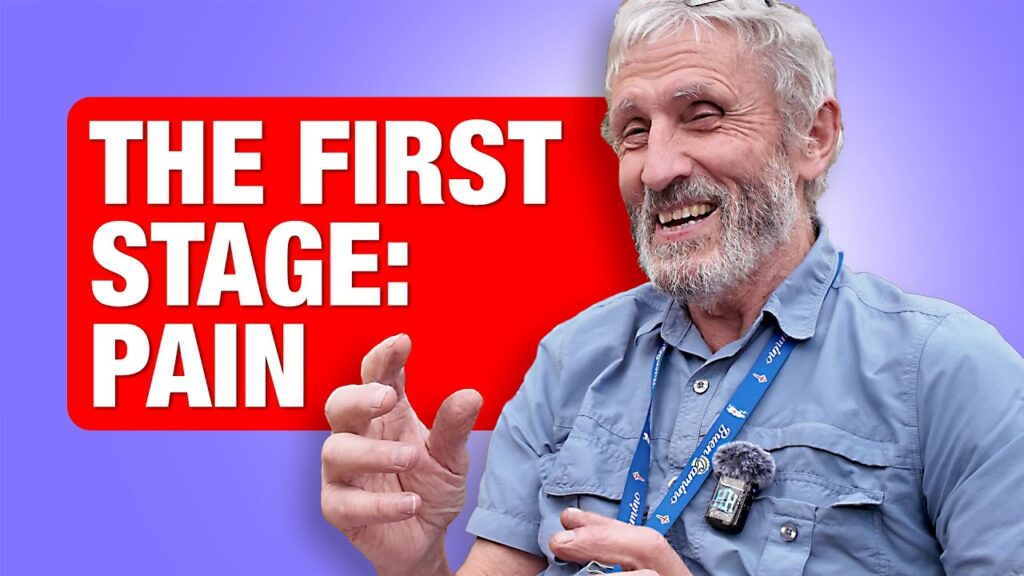
In this video of about twenty-eight minutes, Hans talks with Rob, a Welsh volunteer hospitalero serving pilgrims at the confraternity-run refuge in Rabanal del Camino. Rob explains why he left a well-paid job about thirty years ago, how he sees spirituality as a pragmatist, and what he believes the Camino does to people over its first weeks.
These are one man’s personal views, offered as one voice among many. Rob speaks only for himself, and nothing here is an endorsement of any belief as fact.
Walking out
Rob says he comes from South Wales, with a background in industry, outdoor education and expedition work. He was in a well-paid job when circumstances he felt were unacceptable led him to walk out, and he says he has not had a job since. He has been a carpenter, blacksmith, sailor and medic, always doing things he wanted to do rather than had to do, earning enough to get by. He dislikes the word retired, which to him suggests stopping and playing golf. He edits the magazine of the Confraternity of St James in London, and spends close to three weeks at a time at the refuge, in a day that runs from about 5:45 in the morning to 11 at night.
A two-way street
He insists he is not simply a generous person: he says he gets more out of hosting than the pilgrims do. Sharing his skills gives him what he calls personal empowerment, and sitting at a table with twenty strangers each night, people he would never otherwise have met, makes him feel blessed. He says that when he dies, his knowledge should not be wasted, and that it lives on in his children, in the people he touches, and now, he says to Hans, in this conversation.
Spirituality for a pragmatist
Rob says he is not religious and does not believe in a deity as such. He gives an evolutionary sketch: a brain developed for survival, then agriculture and spare time, and a curious mind that wants explanations. In his view, life carries two opposing forces, empowerment and disempowerment, and modern society, with its owned property, rules and constant outside stimulus, tilts toward the second. He suggests that people look to others to tell them what to believe and what is funny, and that the Camino is different.
He thinks religions share a need for a parental figure: to be looked after, loved and corrected. He says no one can prove or disprove a god, and calls the human mind a wet computer that invents something to cushion the fact that one day it will not be here. He offers this as his own reading, not a claim about what is true.
What the Camino does
According to Rob, the first stage of the Camino is pain: the first week hurts everybody. People carry on because of the people they meet, a thousand-year-old ribbon of humanity rolling across northern Spain, and because the walk gives something rare: time to think. He recalls studying why people love the outdoors and concluding that it is not what is out there but what is not: the pressures of society and media. What is left is you and others doing the same thing.
That time, he says, leads to metacognition, thinking about the way you think. Around three weeks in, he sees clarity arrive, and many of the problems people brought have been solved by the time they reach Santiago. Then comes a kind of grief, because the ribbon ends at a stone in the square and the friends you made are unlikely to be seen again. His answer is to plan the next Camino, ideally alone and without expectations. Rucksacks, he says, are full of fears, and the Camino tells you what you need, not what you want.
Cake as communion
Rob bakes cakes at the refuge, and he describes the cake as a way of creating a sharing experience around the table, much like communion. Pilgrims eat it and take the experience away with them. That care, he says, is what makes this refuge different.
How to read it
This article is based on auto-generated English captions, so some details may differ from what was said. Rob’s remarks about human evolution and religion are his personal views, not scientific or theological claims, and other guests on this channel see these questions very differently. What many viewers may recognise is the value of unhurried time and of listening to strangers.
Questions to take with you
If money were not the reason, what would you do with your days? When did you last give yourself time to think about how you think? Related talks on this site include My Life Was Over, Then I Walked the Camino. Watch the video above and tell us in the comments what you took from it.